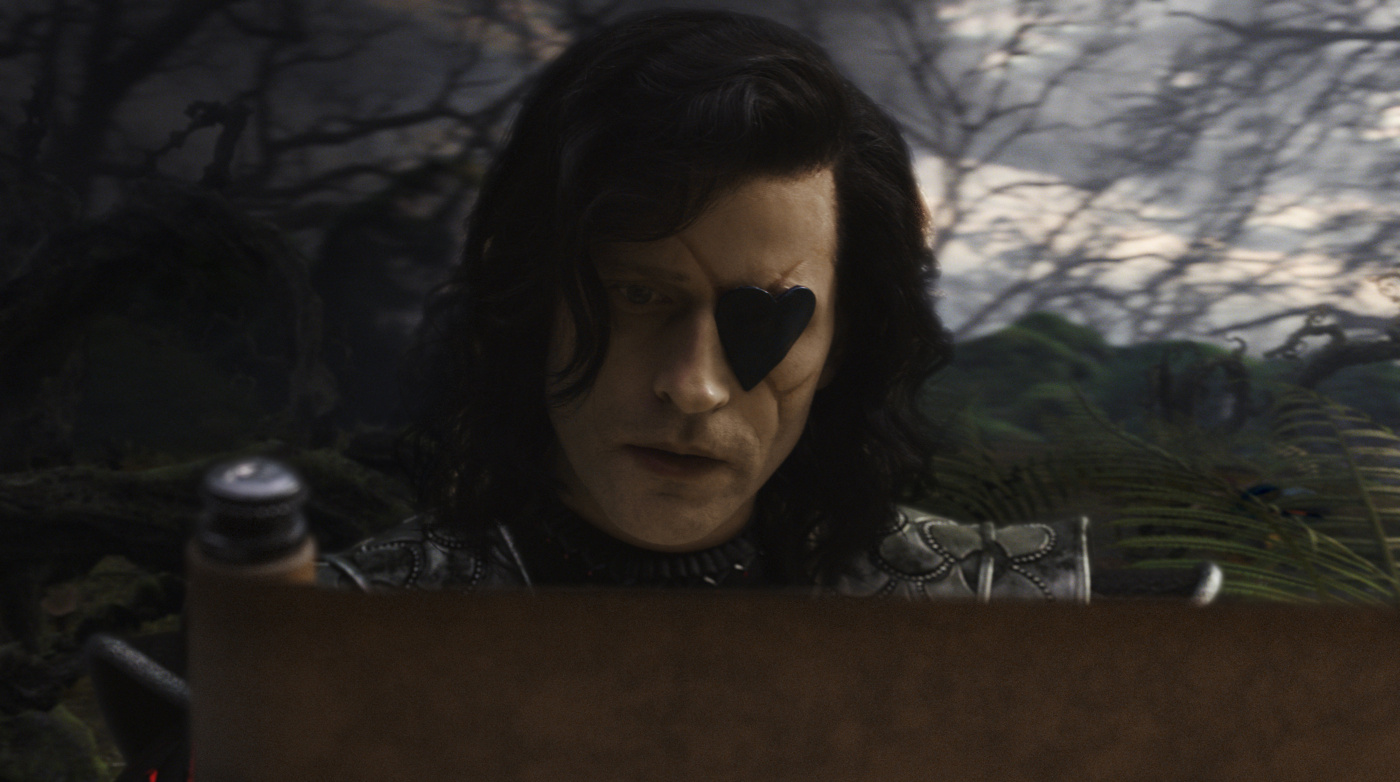
"ALICE IN WONDERLAND" (2010) ReviewI never understood director Tim Burton’s decision to name his 2010 film, "ALICE IN WONDERLAND". I mean . . . why did he do it? This movie was not another adaptation of Lewis Carroll’s 1865 novel, "Alice's Adventures in Wonderland". It was a sequel set thirteen years after the original story. So why use the shortened version of the title from Carroll’s original title? Many of you might be wondering why I had just made a big deal about this movie’s title. For me, it represented an example of what I consider to be the numerous missteps that prevented me from embracing Burton’s new movie. Before I continue, I should confess that I have never been a Tim Burton fan. Never. I can only recall two of his movie that knocked my socks off – 1994’s "ED WOOD" and the 2007 Golden Globe winner, "SWEENY TODD". I wish I could include "ALICE IN WONDERLAND" in that category, but I cannot. The movie simply failed to impress me.As I had stated earlier, ”ALICE IN WONDERLAND” was a sequel to Carroll’s original story. Thirteen years after her original adventures in Wonderland, Alice Kingsleigh has become a nineteen year-old young woman on the verge of accepting a wedding proposal from one Hamish Ascot, the son of her late father’s partner, Lord Ascot. Unfortunately, Hamish is a shallow and self-absorbed young man with very little character. Salvation arrived during Hamish’s very public marriage proposal, when Alice spotted a familiar figure – the same White Rabbit who had previously lured her to Wonderland – scampering across Lord Ascot’s estate. History repeated itself when Alice fell down into the rabbit hole. However, she soon discovered that Wonderland (or Underland) had changed during her thirteen years absence. The Red Queen had managed to wreck havoc and assume control over most of Underland, thanks to her new ”champion” - a dragon known as the Jabberwocky. Only the realm of the Red Queen’s sister, the White Queen, has remained beyond the red-haired monarch’s reach. However, that situation threatened to change if the White Queen fails to acquire her own champion. A scroll called “the Oraculum” predicted that Alice will not only be the White Queen’s champion, but she will also defeat the Jabberwocky and end the Red Queen’s reign of terror. But due to her stubborn belief that Underland was and still is nothing but a dream, Alice was reluctant to take up the mantle of the White Queen’s champion. Judging by the plot I had just described, ”ALICE OF WONDERLAND” should have been an enjoyable movie for me. Granted, Linda Woolverton’s script seemed like a typical ”slay the dragon” storyline that has been used in numerous fantasies. But it still had enough adventure, intrigue and personal angst for me to find it appealing. So, why did it fail to light my fire? Production designer Robert Stromberg created an interesting mixture of Gothic and animated styles for the film’s visuals in both the England and Wonderland sequences. Anthony Almaraz and his team of costume designers created lush and colorful costumes for the cast. And Dariusz Wolski’s photography brought out the best in the movie’s visual styles. ”ALICE IN WONDERLAND” could also boast some first-rate performances from the cast. Johnny Depp gave a wonderfully complicated performance as the Mad Hatter. His Mad Hatter was an interesting mixture of an extroverted personality and pathos, punctuated by bouts of borderline insanity. The Red Queen might possibly be one of Helena Bonham-Carter’s best roles. She struck me as the epitome of childishness, selfishness and cruelty. Crispin was slick, menacing and subtly funny as the Red Queen’s personal henchman, the Knave of Hearts. Anne Hathaway’s delicious portrayal of the White Queen reminded me of a Disney princess on crack. I really enjoyed it. Both Tim Piggott-Smith and Geraldine James (who were both in the 1985 miniseries, ”JEWEL IN THE CROWN”) gave solid performances as Alice’s potential in-laws - the kindly Lord Ascot and his shrewish and bullying wife, Lady Ascot. And Alan Rickman gave voice to the Blue Caterpillar in a deliciously sardonic performance. Despite my positive opinion of most of the film’s technical aspects and performances, it still failed to impress me. Why?First of all, the movie rested upon the shoulders of Australian actress, Mia Wasikowska as the lead character, Alice Kingsleigh. I understand that Ms. Wasikowska has recently received critical acclaim for her portrayal of a suicidal teen in HBO’s ”IN TREATMENT”. It seemed a pity that she failed to be just as impressive as Alice in ”ALICE IN WONDERLAND”. Some people have labeled her performance as ”subtle”. I would call it ”insipid”. Or perhaps just plain boring. I swear I have never come across such a bland and boring performance in my life. No only did Wasikowska managed to make Alice’s battle against the Jabberwocky seem dull, she still came close to putting me to sleep in her character’s moments of triumph in the movie’s finale.Tim Burton’s direction of ”ALICE IN WONDERLAND” proved to be just as uninspiring to me, as Wasikowska’s performance. Actually, I found myself thinking of the 1992 movie, ”DEATH BECOMES HER”. I was not comparing the visual effects between the two movies. Meryl Streep had uttered a word in the 1992 movie that perfectly described my opinion of Burton’s direction. Flaccid. ”FLA-A-A-A-CI-I-ID!” How did a director with Burton’s reputation managed to take a solid fantasy adventure and make it one of the most boring films in recent Hollywood history is beyond me. His direction lacked any pep. Or spark. I had felt as if I was watching a piece of limp lettuce in action. I even began to wonder if Burton’s dull direction had affected Wasikowska’s performance. Then I remembered that actors like Depp and Bonham-Carter managed to rise above his direction. I might as well dump the blame of Wasikowska’s performance on her shoulders. Or perhaps Alice was simply a dull character. After all, Wasikowska has proven to be a superb actress in future movies. As for Tim Burton . . . what is there to say? His direction simply disappointed me. I might as well say something about the movie’s 3-D effects. They were not only disappointing to me, but also a waste of time and the extra cash I had to pay for the movie tickets. I did not care for the 3-D effects in ”AVATAR”, but it was an example of technical wizardry in compare to the 3-D photography shown in ”ALICE IN WONDERLAND”. Speaking of ”AVATAR”, I have one last thing to say in regard to 3-D . . . ’Damn you, James Cameron!”. Seriously. I would like to take the man’s head and bash it through a wall for introducing 3-D to the movie going experience. In the two movies I have seen it in, I found it unimpressive. Worse, I had to pay extra movie because movie theaters are more willing to show the 3-D versions of movies like ”ALICE IN WONDERLAND”, instead of the 2-D versions.In short, "ALICE IN WONDERLAND" had all of the hallmarks of a solid and entertaining movie experience for me. It was the continuation of a classic fantasy adventure. Talented actors like Johnny Depp, Helena Bonham-Carter, Crispin Glover and Anne Hathaway gave first-rate performances. And I must admit that the movie’s production designs and photography gave it a unique visual style. But all of that could not save a movie hindered by pedestrian 3-D effects, a dull and insipid performance by Mia Wasikowska and an even more insipid direction by Tim Burton. Frankly, I think it is a miracle that this movie managed to become a box-office hit.
 "LAWLESS" (2012) ReviewA Virginia-born writer named Matt Bondurant wrote a historical novel called "The Wettest County in the World" back in 2008. He based the novel on the exploits of his grandfather and two granduncles, who ran a massive moonshine operation during the later years of the Prohibition era, in the mountains of southwest Virginia. Four years later, a movie version of Bondurant's novel finally hit the movie screens at the end of the summer. Renamed "LAWLESS", the movie began in 1931 in Franklin County, Virgina; where three brothers - Forest, Howard and Jack Bondurant - run a successful moonshine business with the help of their friend, Cricket Pate. The brothers use a bar as a front for their illegal activities. And not only do they provide well-made moonshine to the Franklin County locals, but also to gangsters like Floyd Banner of Chicago. Two people arrive in Franklin County that prove to have a major impact upon the lives the Bondurant brothers. The first to arrive is a Chicago dancer named Maggie Beauford, who is hired as a waitress for their bar and slowly becomes romantically involved with the oldest brother, Forest. Not long after Maggie's arrival, a Federal Special Deputy Charly Rakes arrives in Franklin County and demands that all county bootleggers - including the Bondurants - give him a cut of their profits. Although the other bootleggers surrender to Rakes' intimidation tactics and decide to give him a cut, Forest Bondurant refuses to do the same. Rakes and his men set out to intimidate and terrorize the Bondurants into giving him a cut of their profits. And when that fails, he decides to go after their distillery and destroy it.Most of the story is told through the eyes of the youngest Bondurant - Jack. At the beginning of the story, Jack is an inexperienced and sometimes introverted young man, who is kept out of the family's shine business, aside from acting as a driver for their deliveries. When Rakes gives him a severe beating as a warning to the family, Forest chides Jack for being unable to defend himself. But after Forest is nearly killed by two of Rakes' men, Jack takes matters into his hands and sets with his friend Cricket to deliver a shipment of booze to Floyd Banner in Chicago. Jack returns with profit for the family and himself. But his newly discovered self confidence leads him to make mistakes that not only endanger his family's moonshine operation, but also the lives of Cricket and the girl he loves, a German-American Baptist named Bertha Mannix."LAWLESS" turned out to be a very entertaining movie for me. But before I discuss how much I enjoyed the movie, I have to talk about its flaws. I believe that "LAWLESS" had two major flaws. One, director John Hillcoat delivered an unevenly paced movie. The first third of the movie took its time in setting up both the characters and the story. In fact, the pacing was so slow that I was in danger of either falling asleep or losing interest in the movie. I have one last complaint and it deals with the movie's introduction of the Floyd Banner character. I found the introduction of the Banner character rather irrelevant and unnecessary. In the movie, Banner arrived in Franklin County to shoot a competitor, exchange a glance with Jack Bondurant and return to Chicago. I found the entire scene irrelevant and a skimpy excuse to introduce Gary Oldman into the film. Especially since the Floyd Banner role proved to be rather small and serve as nothing more than a plot device to increase Jack's role as a moonshiner.But once the movie was set up, "LAWLESS" proved to be very satisfying and entertaining. One aspect of the film that I truly enjoyed was the manner in which it recaptured so many details of early Depression-era Appalachian South. Hillcoat did a marvelous job in allowing the movie to permeate with atmosphere. However, Hilcoat did not achieve this superb re-creation on his own. He received help from the likes of cinematogrpher Benoît Delhomme, whose photography of the western Georgia locations struck me as breathtaking; Gershon Ginsburg's beautiful art direction and Chris Kennedy's production designs. I was especially impressed by Margot Wilson's costume designs. For years, Hollywood seemed to have difficulty in re-creating accurate costumes for the early 1930. The movie industry has improved a great deal over the past decade or so. And this was especially apparent in how Wilson's costumes not only accurately reflect the movie's period setting, but also the character and social positions of the characters. An excellent example of this proved to be the costumes worn by Shia Labeouf. He began the movie wearing clean, yet tight fitting clothes - including pants that were obviously too short. During the movie's second half, his wardrobe not only improved, but also became decidedly more flashy, reflecting his personal success in the moonshine business.Although I found screenwriter Nick Cave's introduction of the movie's character, setting and plot rather slow; I must admit that the movie's overall story proved to be well written. I wonder if many critics and moviegoers had suspected "LAWLESS" would end up as some dramatic version of "THE DUKES OF HAZZARD" with plenty of high-octane action and cliched Southern stock characters. Or that it would turned out to be some take on the founding of NASCAR. Thankfully, none of those scenarios came to fruition. "LAWLESS"proved to be an intelligent mixture of a well done family drama and crime saga. First of all, Cave's script not only explored the Bondurants' illegal activities and how it attracted the attention of the law, symbolized in the form of the corrupted Federal officer Charly Rakes. But it also explored the Bondurants themselves - the intimidating Forest, who had developed a reputation for evading death; the easy-going and hard-drinking Howard, who also possessed a hair triggered temper; and youngest brother Jack, whose inexperience, introverted nature and distaste for violence led him to be disregarded by his older brothers as a dependable participant in their moonshine business.The producers and Hilcoat certainly picked the right actors to portray the Bondurant brothers. I hope that Shia Labeouf will finally shake off his reputation as a mere tool dominated by special effects in over-the-top action films. He did a superb job in slowly developing Jack Bondurant's character from the insecure and immature boy to someone with a lot more confidence. I believe that Forest Bondurant might prove to be one of my favorite roles that Tom Hardy has ever portrayed. He did a marvelous job projecting an intimidating and commanding aura in his character. The character attracted a bit of a in-joke that originated with a local myth that nothing or no one call kill him. It was good to see Jason Clarke again, whom I have not seen in a movie since 2009's "PUBLIC ENEMIES". He was great as the easy going, yet hard drinking middle brother Howard.I noticed that Australian actress Mia Wasikowska received a higher billing in the movie's credits than Jessica Chastain. I am a bit surprised, considering that her role proved to be smaller. Mind you, I had no problems with her solid portrayal of Jack Bondurant's love, Bertha Minnix. But her performance and role seemed minor in compare to Chastain, who had the juicier role as Chicago showgirl-turned-waitress, Maggie Beauford. Chastain was superb as world weary dancer who left Chicago to escape its chaos and mindless violence, only to find herself in the middle of more chaos in the form of the Bondurants' feud with Charly Rakes. And I was especially impressed with one scene between her and Hardy, as she struggled to suppress news of the rape she had endured at the hands of Forest's attackers. Many critics claimed that Gary Oldman had chewed the scenery in his brief appearance as Chicago gangster Floyd Banner. Aside from one moment when he lost his temper with a subordinate, I found Oldman's performance rather subdued. And he did a pretty good job in his one major scene. I believe that many critics had managed to overlook Guy Pearce's over-the-top performance as Federal deputy, Charly Rakes. With his slicked back hair, shaved eyebrows, exaggerated body language and effiminate manner, Pearce radiated urban eccentricity at its extreme. Yet, for some reason, the performance worked, due to Pearce's ability to infuse a great deal of subtle menace within the exaggerated persona. The movie also benefited from some solid performances from the likes of Dane DeHaan, who portrayed Jack's best friend Cricket Pate; Bill Camp, who portrayed Franklin County's backbone, Sheriff Hodges; and Lew Temple as the morally questionable Deputy Henry Abshire.I realize that "LAWLESS" is not perfect. I feel that the slow pace in the first third of the film and the unnecessary manner of the Floyd Banner character's introduction prevented it from being a truly first-rate movie. But thanks to Nick Cave's adaptation of Matt Bondurant's tale, solid direction from John Hillcoat and a superb cast led by Shia Labeouf and Tom Hardy, "LAWLESS" still managed to become a fascinating tale of family bonds during the last years of Prohibition . . . and one of my favorite movies of the 2012 summer season.
 Below is my review of the new biographical film on Amelia Earhart, the famous aviatrix from the 1930s: "AMELIA" (2009) ReviewTo this day, there have been at least three biographical movies about the 1930s aviatrix, Amelia Earhart. And I have not seen the first two films – a 1943 movie that starred Rosalind Russell and a 1976 television movie that starred Susan Clark. I finally got around to seeing the latest biopic film about Earhart called ”AMELIA”. Directed by Mira Nair, the film starred two-time Oscar winner Hilary Swank in the title role. Written by Ronald Bass and Anna Hamilton Phelan, the screenplay was based upon research from sources like ”East to the Dawn” by Susan Butler and ”The Sound of Wings” by Mary S. Lovell. Instead of covering Earhart’s entire life, the story focused purely on the aviatrix’s career as a pilot from her first flight over the Atlantic Ocean in 1928 (as a passenger) to her disappearance over the Pacific Ocean in an attempt to circumnavigate the globe in 1937. The movie also focused upon Earhart’s relationships with publishing tycoon and husband George Putnam (Richard Gere) and her lover, aviator Gene Vidal (Ewan McGregor); along with her collaboration with navigator Fred Noonan (Christopher Eccleston) during that last flight.I can honestly say that ”AMELIA” is not one of the greatest Hollywood biographical films I have ever seen. It is not the worst . . . but I have certainly seen better biopics. The problem with ”AMELIA” is that it is simply mediocre. I am aware that the aviatrix had accomplished a great deal during her flying career. The film began with her becoming the first female to fly over the Atlantic as commander of the flight . . . and as a passenger. Embarrassed that her fame had not been earned, Earhart finally became the first female to fly over the Atlantic as a pilot in 1932. And although I felt a little teary-eyed and a sense of satisfaction over her accomplishments, I still found the movie to be a bit mediocre. For me, the movie’s main problem seemed to focus upon its portrayal of the main character – namely Earhart. I might as well be honest. The problem could have been Hilary Swank’s portrayal of the aviatrix. Or the problem simply could have been Bass and Phelan’s portrayal of her. She was not that interesting as a personality. Mind you, Earhart was not portrayed as a saint in the film. It included her alleged affair with Gene Vidal, during her marriage to Putnam, she had an affair with pilot Gene Vidal. Yet, Earhart still managed to come off as a less than interesting personality.But all was not lost with ”AMELIA”. It included a handful of scenes that I found memorable. These scenes featured Earhart’s clash with Wilmer “Bill” Stultz (Joe Anderson) before the 1928 trans-Atlantic flight, that particular flight, George Putnam’s jealously over Earhart’s relationship with Vidal, her 1932 solo flight across the Atlantic, and her brief disagreement with Fred Noonan during their overnight stay in Lae, Papual New Guinea. The film’s minor centerpiece focused on those last moments of communication between Earhart’s plane and a U.S. Coast Guard picket ship called the U.S.C.G.C. Itasca before she and Noonan disappeared. I found myself especially impressed with Nair’s handling of this last scene, despite the fact that everyone knew its outcome.Hilary Swank gave a solid and understated performance as Earhart. Considering that the aviatrix’s personality was understated, I doubt that it was much of a stretch for. I am a big fan of Ewan McGregor, but I think he was basically wasted in the role of Gene Vidal. Aside from providing a few romantic moments and expressing concern for Earhart’s plans to circumnavigate the globe, he really did not do much. On the other hand, I did enjoy Christopher Eccleston’s performance as the alcoholic navigator, Fred Noonan. He did not appear in that many scenes, but I really enjoyed the tension between him and Swank as they played out Noonan’s subtle, yet drunken come-on in Lae. In the end, it was Richard Gere who gave the most interesting performance. He gave an exuberant performance as the celebrated publisher/publicist George Putnam. Gere also gave audiences a glimpse into Putnam’s jealousy over Earhart’s relationship with Vidal – a jealousy that led him to propose marriage to the aviatrix in the first place. But in the end, not even Gere’s performance could provide enough energy to rejuvenate this film.If there is one aspect of ”AMELIA” that I truly enjoy, it was the look of the film. Thanks to Stephanie Carroll’s production designs, Nigel Churcher and Jonathan Hely-Hutchinson’s art direction, Kasia Walicka-Maimone’s costume designs, and Stuart Dryburgh’s photography; the movie managed to capture – somewhat – the sleek Art Deco look of the late 1920s and the 1930s. Mind you, not all of it was historically accurate. However, I have come to the point where I find it useless to complain about historical accuracy in a movie with a historical backdrop. I wish I could say something about Gabriel Yared’s score, but I found nothing memorable about it.I suspect that ”AMELIA” barely made a budge in the box office return. Not surprising. It is not a memorable film. It would probably turn out to be one of those films I would not mind watching on cable television or renting it from NETFLIX. Like I had stated earlier, it is not a terrible film. I doubt that it will go down in history as a memorable historical drama. If you want my opinion, I would suggest that you either wait until this movie is released on cable . . . or wait until it is released on DVD and rent it.