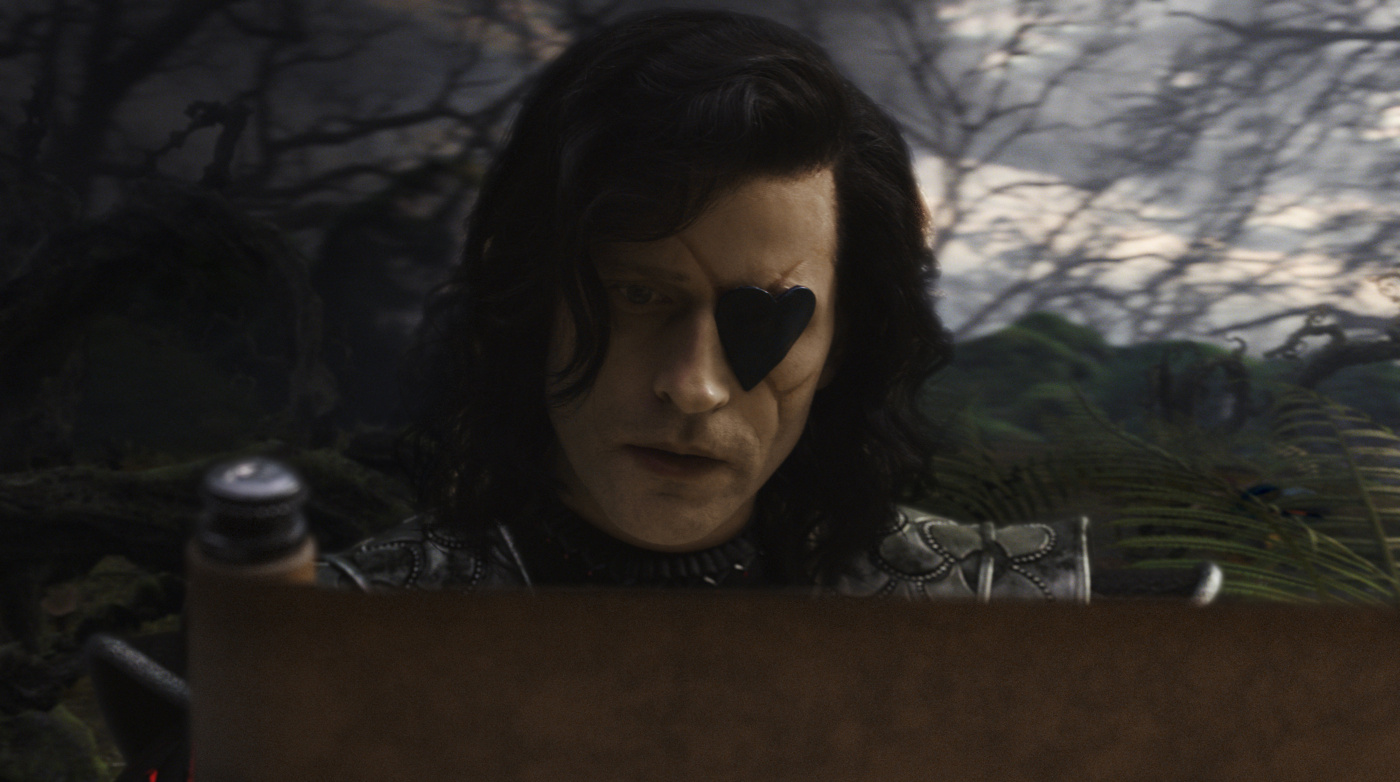
"ALICE IN WONDERLAND" (2010) ReviewI never understood director Tim Burton’s decision to name his 2010 film, "ALICE IN WONDERLAND". I mean . . . why did he do it? This movie was not another adaptation of Lewis Carroll’s 1865 novel, "Alice's Adventures in Wonderland". It was a sequel set thirteen years after the original story. So why use the shortened version of the title from Carroll’s original title? Many of you might be wondering why I had just made a big deal about this movie’s title. For me, it represented an example of what I consider to be the numerous missteps that prevented me from embracing Burton’s new movie. Before I continue, I should confess that I have never been a Tim Burton fan. Never. I can only recall two of his movie that knocked my socks off – 1994’s "ED WOOD" and the 2007 Golden Globe winner, "SWEENY TODD". I wish I could include "ALICE IN WONDERLAND" in that category, but I cannot. The movie simply failed to impress me.As I had stated earlier, ”ALICE IN WONDERLAND” was a sequel to Carroll’s original story. Thirteen years after her original adventures in Wonderland, Alice Kingsleigh has become a nineteen year-old young woman on the verge of accepting a wedding proposal from one Hamish Ascot, the son of her late father’s partner, Lord Ascot. Unfortunately, Hamish is a shallow and self-absorbed young man with very little character. Salvation arrived during Hamish’s very public marriage proposal, when Alice spotted a familiar figure – the same White Rabbit who had previously lured her to Wonderland – scampering across Lord Ascot’s estate. History repeated itself when Alice fell down into the rabbit hole. However, she soon discovered that Wonderland (or Underland) had changed during her thirteen years absence. The Red Queen had managed to wreck havoc and assume control over most of Underland, thanks to her new ”champion” - a dragon known as the Jabberwocky. Only the realm of the Red Queen’s sister, the White Queen, has remained beyond the red-haired monarch’s reach. However, that situation threatened to change if the White Queen fails to acquire her own champion. A scroll called “the Oraculum” predicted that Alice will not only be the White Queen’s champion, but she will also defeat the Jabberwocky and end the Red Queen’s reign of terror. But due to her stubborn belief that Underland was and still is nothing but a dream, Alice was reluctant to take up the mantle of the White Queen’s champion. Judging by the plot I had just described, ”ALICE OF WONDERLAND” should have been an enjoyable movie for me. Granted, Linda Woolverton’s script seemed like a typical ”slay the dragon” storyline that has been used in numerous fantasies. But it still had enough adventure, intrigue and personal angst for me to find it appealing. So, why did it fail to light my fire? Production designer Robert Stromberg created an interesting mixture of Gothic and animated styles for the film’s visuals in both the England and Wonderland sequences. Anthony Almaraz and his team of costume designers created lush and colorful costumes for the cast. And Dariusz Wolski’s photography brought out the best in the movie’s visual styles. ”ALICE IN WONDERLAND” could also boast some first-rate performances from the cast. Johnny Depp gave a wonderfully complicated performance as the Mad Hatter. His Mad Hatter was an interesting mixture of an extroverted personality and pathos, punctuated by bouts of borderline insanity. The Red Queen might possibly be one of Helena Bonham-Carter’s best roles. She struck me as the epitome of childishness, selfishness and cruelty. Crispin was slick, menacing and subtly funny as the Red Queen’s personal henchman, the Knave of Hearts. Anne Hathaway’s delicious portrayal of the White Queen reminded me of a Disney princess on crack. I really enjoyed it. Both Tim Piggott-Smith and Geraldine James (who were both in the 1985 miniseries, ”JEWEL IN THE CROWN”) gave solid performances as Alice’s potential in-laws - the kindly Lord Ascot and his shrewish and bullying wife, Lady Ascot. And Alan Rickman gave voice to the Blue Caterpillar in a deliciously sardonic performance. Despite my positive opinion of most of the film’s technical aspects and performances, it still failed to impress me. Why?First of all, the movie rested upon the shoulders of Australian actress, Mia Wasikowska as the lead character, Alice Kingsleigh. I understand that Ms. Wasikowska has recently received critical acclaim for her portrayal of a suicidal teen in HBO’s ”IN TREATMENT”. It seemed a pity that she failed to be just as impressive as Alice in ”ALICE IN WONDERLAND”. Some people have labeled her performance as ”subtle”. I would call it ”insipid”. Or perhaps just plain boring. I swear I have never come across such a bland and boring performance in my life. No only did Wasikowska managed to make Alice’s battle against the Jabberwocky seem dull, she still came close to putting me to sleep in her character’s moments of triumph in the movie’s finale.Tim Burton’s direction of ”ALICE IN WONDERLAND” proved to be just as uninspiring to me, as Wasikowska’s performance. Actually, I found myself thinking of the 1992 movie, ”DEATH BECOMES HER”. I was not comparing the visual effects between the two movies. Meryl Streep had uttered a word in the 1992 movie that perfectly described my opinion of Burton’s direction. Flaccid. ”FLA-A-A-A-CI-I-ID!” How did a director with Burton’s reputation managed to take a solid fantasy adventure and make it one of the most boring films in recent Hollywood history is beyond me. His direction lacked any pep. Or spark. I had felt as if I was watching a piece of limp lettuce in action. I even began to wonder if Burton’s dull direction had affected Wasikowska’s performance. Then I remembered that actors like Depp and Bonham-Carter managed to rise above his direction. I might as well dump the blame of Wasikowska’s performance on her shoulders. Or perhaps Alice was simply a dull character. After all, Wasikowska has proven to be a superb actress in future movies. As for Tim Burton . . . what is there to say? His direction simply disappointed me. I might as well say something about the movie’s 3-D effects. They were not only disappointing to me, but also a waste of time and the extra cash I had to pay for the movie tickets. I did not care for the 3-D effects in ”AVATAR”, but it was an example of technical wizardry in compare to the 3-D photography shown in ”ALICE IN WONDERLAND”. Speaking of ”AVATAR”, I have one last thing to say in regard to 3-D . . . ’Damn you, James Cameron!”. Seriously. I would like to take the man’s head and bash it through a wall for introducing 3-D to the movie going experience. In the two movies I have seen it in, I found it unimpressive. Worse, I had to pay extra movie because movie theaters are more willing to show the 3-D versions of movies like ”ALICE IN WONDERLAND”, instead of the 2-D versions.In short, "ALICE IN WONDERLAND" had all of the hallmarks of a solid and entertaining movie experience for me. It was the continuation of a classic fantasy adventure. Talented actors like Johnny Depp, Helena Bonham-Carter, Crispin Glover and Anne Hathaway gave first-rate performances. And I must admit that the movie’s production designs and photography gave it a unique visual style. But all of that could not save a movie hindered by pedestrian 3-D effects, a dull and insipid performance by Mia Wasikowska and an even more insipid direction by Tim Burton. Frankly, I think it is a miracle that this movie managed to become a box-office hit.
 ”HE KNEW HE WAS RIGHT” (2004) Review
My knowledge of 19th century author, Anthony Trollope, can be described as rather skimpy. In fact, I have never read any of his works. But the 2004 BBC adaptation of his 1869 novel, ”He Knew He Was Right”, caught my interest and I decided to watch the four-part miniseries.
”HE KNEW HE WAS RIGHT” told the decline and fall of a wealthy gentleman named Louis Trevelyan (Oliver Dimsdale) and his marriage to the elder daughter of a British Colonial administrator named Sir Marmaduke Rowley (Geoffrey Palmer) during the late 1860s. Louis first met the spirited Emily Rowley (Laura Fraser) during a trip to the fictional Mandarin Islands. Their marriage began on a happy note and managed to produce one son, young Louis. But when Emily’s godfather, the rakish Colonel Osborne (Bill Nighy), began paying consistent visits to her, the house of cards for the Trevelyan marriage began to fall. Doubts about his wife’s fidelity formed clouds in Louis’ mind upon learning about Osborne’s reputation as a ladies’ man. His insistence that Emily put an end to Osborne’s visits, along with her stubborn opposition to his demands and outrage over his lack of trust finally led to a serious break in their marriage. What followed was a minor public scandal over their estrangement, a change of addresses for both husband and wife, Louis’ kidnapping of their son and his final descent into paranoia and madness.
The miniseries also featured several subplots. One centered around the forbidden romance between Emily’s younger sister, Nora (Christina Cole), and a young journalist named Hugh Stansbury (Stephen Campbell Moore), who happened to be Louis’ closest friend. Another featured the efforts of Hugh’s wealthy Aunt Jemima Stansbury (Anna Massey) to pair his younger sister Dorothy (Caroline Martin) to a local vicar in Wells named Reverend Gibson (David Tennant). Unfortunately for Aunt Stansbury, her desires for a romance between Dorothy and Reverend Gibson ended with Dorothy’s rejection of him and his lies about her moral character. Later, Dorothy and Aunt Stansbury found themselves at odds over Dorothy’s friendship and burgeoning romance with the nephew of her old love, Brooke Burgess (Matthew Goode). Gibson found himself in hot water with the socially powerful Aunt Stansbury over his lies about Dorothy. But that was nothing in compare to his being the center of a bitter sibling rivalry between two sisters, Arabella and Camilla French (Fenella Woolgar and Claudie Blakley). One last subplot evolved from Nora Rowley’s rejection of a wealthy aristocrat named Mr. Glascock (Raymond Coulthar). While traveling through Italy, he became acquainted with Caroline Spalding (Anna-Louise Plowman), one of two daughters of an American diplomat; and began a romance with her.
Most of the subplots from ”HE KNEW HE WAS RIGHT” proved to be mildly entertaining or interesting. But the one subplot that really caught my attention featured Reverend Gibson and the French sisters. There were times when I could not even describe this story. I found it hilarious in a slightly twisted and surreal manner. Considering the vicar’s sniveling personality, there were times I felt it served him right to find himself trapped in the rivalry between the sweetly manipulative Arabella and the aggressive Camilla. But when the latter proved to be obsessive and slightly unhinged, I actually found myself rooting for Reverend Gibson to be free of her grasp. In some ways, Camilla proved to be just as mentally disturbed as Louis Treveylan.
For me, the best aspect of ”HE KNEW HE WAS RIGHT” proved to be the main plot about the Treveylan marriage. I have to give kudos to Andrew Davies for his excellent job in adapting Trollope’s tale. I found the Louis and Emily’s story to be fascinating and well written. When their marriage ended in separation at the end of Episode One, I wondered if Davies had rushed the story. Foolish me. I never realized that the separation would lead toward a slow journey into madness for Louis and one of frustration and resentment for Emily. Her resentment increased tenfold after Louis kidnapped their young son, Little Louis; and upon her discovery that as a woman, she did not have the law on her side on who would be considered as the boy’s legal guardian. For me, the most surprising aspect of ”HE KNEW HE WAS RIGHT” was that despite all of the hell Louis forced Emily to endure, I ended up feeling very sorry for him. Due to his own insecurities over Colonel Osborne’s attentions to Emily and her strength of character, Louis ended up enduring a great deal of his own hell.
Another aspect I found rather interesting about ”HE KNEW HE WAS RIGHT” was the topic of power abuse that permeated the tale. Many film and literary critics have used the Louis Trevelyan character as an argument that the story’s main theme was the abuse of paternal or male power. I heartily agree with that argument. To a certain extent. After all, Louis’ hang-ups regarding Emily’s relationship with Colonel Osborne seemed to be centered around her unwillingness to blindly obey him or his fear that he may not be enough of a man for her. And Sir Marmaduke’s insistence that Nora dismiss the idea of marrying the penniless Hugh Stanbury for a wealthier gentleman – namely Mr. Glascock. But the miniseries also touched upon examples of matriarchy or female abuse of power – something that most critics or fans hardly ever mention. Jemima Stanbury’s position as the Stanburys’ matriarch and only wealthy family member gave her the belief she had the power to rule over the lives of her family. This especially seemed to be the case in her efforts to control Dorothy’s love life. Camilla French struck me as another female who used her position as Reverend French’s fiancée to abuse it – especially in her aggressive attempts to ensure that he would give in to her desires and demands. And when that failed, she used her anger and threats of violence to ensure that her sister Arabella did not win in their rivalry over the spineless vicar. Some would say that Camilla was merely indulging in masculine behavior. I would not agree. For I believe that both men and women – being human beings – are capable of violence. For me, aggression is a human trait and not associated with one particular gender. In the end, both Sir Marmaduke and Aunt Stanbury relented to the desires of their loved ones. Camilla had no choice but to relent to Arabella’s victory in their race to become Reverend Gibson’s wife, thanks to her mother and uncle’s intervention. As for Louis, he continued to believe he was right about Emily and Colonel Osborne . . . at least right before the bitter end.
Oliver Dimsdale proved to be the right actor to portray the complex and tragic Louis Trevelyan. He could have easily portrayed Louis as an unsympathetic and one-note figure of patriarchy. Instead, Dimsdale skillfully conveyed all of Louis’ faults and insecurities; and at the same time, left me feeling sympathetic toward the character. Dimsdale’s Louis was not a monster, but a flawed man who believed he could control everything and especially everyone in his life. And this trait proved to be his Achilles heel. But despite my sympathies toward him, I could never accept the righteousness of Louis’ behavior. And the main reason proved to be Laura Fraser’s portrayal of the high-spirited and stubborn Emily Rowley Trevelyan. One could say that Emily should have conceded to her husband’s wishes. As the spouse of a pre-20th century male, one would expect her to. I could point out that she did concede to Louis’ wishes – while protesting along the way. And Fraser not only did a marvelous job with Emily’s strong will and stubbornness, but also anger at Louis’ paternalism. Amazingly, she also effectively portrayed Emily’s continuing love for Louis and doubts over the character’s actions with a great deal of plausibility. This last trait was especially apparent in Emily’s conversations with Hugh Stanbury’s sister, Priscilla, in Episode Two. And both Dimsdale and Fraser created a strong and credible screen chemistry, despite their characters’ flaws, mistakes and conflicts.
Another reason I managed to enjoy ”HE KNEW HE WAS RIGHT” turned out to be the solid performances by the supporting cast. However, several performances stood out for me. Three came from veteran performers such as Bill Nighy, Anna Massey and Ron Cook. Nighy, ever the chameleon, gave a delicious performance as the mischievous and rakish Colonel Osborne; who proved to be something of a blustering phony in the end. Anna Massey gave a wonderful and entertaining portrayal as the wealthy matriarch of the Stanbury family, Jemima Stanbury. Despite being a tyrannical and no-nonsense woman, Massey’s Aunt Stanbury also proved to be a likeable and vulnerable individual. And Cook did a marvelous job in portraying Mr. Nozzle as more than just a study in one-dimensional seediness. Cook aptly conveyed the private detective’s conflict between his greedy desire for Louis’ business and his sympathy toward Emily’s plight.
The second trio of performances that impressed me came from David Tennant, Fenella Woolgar and Claudie Blakley, who portrayed the Reverend Gibson and the French sisters. Tennant, who was two years away from portraying the 10th Doctor Who, gave a hilarious performance as the avaricious vicar with a spine made from gelatin. Both Woolgar and Blakley were equally funny as the two sisters battling for his affections . . . or at least a marriage proposal. Blakley also seemed a tad frightening, as she delved into Camilla’s aggressive and homicidal determination to prevent Mr. Gibson from returning his “affections” to the more mild-tempered and manipulative Arabella.
The production values for ”HE KNEW HE WAS RIGHT” seemed pretty solid. But I found nothing exceptional about it, except for Mike Eley’s photography and Debbie Wiseman’s haunting score, which seemed appropriate for the Trevelyans’ doomed marriage. However, I do have one major problem with Trollope’s tale . . . and Davies’ script. Quite simply, the story suffered from one too many subplots. Many have counted at least five subplots in ”HE KNEW HE WAS RIGHT”and they would be correct. At least three of them – Dorothy’s problems with Reverend Gibson, her conflict with Aunt Stanbury over Brooke Burgess, and Reverend Gibson’s problems with the French sisters – having nothing to do with the main storyline. Despite the fact that I found them either interesting or entertaining, I felt as if they belonged in another novel or series. I realize that Trollope had used these subplots as examples of comparisons to the Trevelyan marriage, but I always have this strange sensation that I am watching a completely different series altogether. I believe that Davies should have realized this before writing his script.
Despite my problems with the tale’s numerous subplots, I found ”HE KNEW HE WAS RIGHT” to be a first-rate adaptation of Anthony Trollope’s novel. I must admit that all of the plotlines proved to be interesting. And Tom Vaughn’s direction, along with a first-rate cast led by Oliver Dimsdale and Laura Fraser, ”HE KNEW HE WAS RIGHT” proved to be a literary adaptation worth watching.