Below are images from the 2012 drama called "THE MASTER". Written and directed by Paul Thomas Anderson, the movie starred Oscar nominees Joaquin Phoenix, Philip Seymour Hoffman and Amy Adams:
"THE MASTER" (2012) Photo Gallery
 "LOUISIANA" (1984) ReviewThirty-six years ago, HBO had aired a three-part miniseries about the life and travails of a nineteenth century Southern belle named Virginia Tregan. The miniseries was called "LOUISIANA" and it starred Margot Kidder and Ian Charleson.Directed by the late Philippe de Broca, "LOUISIANA" was based upon the "Fausse-Riviere" Trilogy, written by Maurice Denuzière, one of the screenwriters. It told the story of Virginia's ruthless devotion to her first husband's Louisiana cotton plantation called Bagatelle . . . and her love for the plantation's overseer, an Englishman named Clarence Dandridge. The story begins in 1836 in which she returns to her home in Louisiana after spending several years at school in Paris. Unfortunately, Virginia discovers that the Tregan family plantation and most of its holdings have been sold to pay off her father’s debts. Only the manor house remains. Determined to recoup her personal fortune, Virginia manipulates the breakup of the affair between her wealthy godfather, Adrien Damvillier and his mistress, Anne McGregor in order to marry him and become mistress of Bagatelle. Virginia also becomes frustrated in her relationship with Clarence Dandridge, who refuses to embark upon a sexual relationship with her.During their ten-year marriage, Virginia and Adrien conceive three children – Adrien II, Pierre and Julie. Not long after Julie’s birth, Adrien dies during a yellow fever epidemic. Virginia hints to Clarence that she would like to engage in a serious relationship with him. But when he informs her that they would be unable to consummate their relationship due to an injury he had sustained during a duel, Virginia travels to Paris for a year-long separation. There, she meets her second husband, a French aristocrat named Charles de Vigors. They return to Louisiana and Virginia gives birth to her fourth and final child – Fabian de Vigors. Virginia and Charles eventually divorce due to his jealousy of his wife’s feelings for Clarence and his affairs. Fabian, who feels left out of the Damvillier family circle, accompanies his father back to France. During the next ten to fifteen years, Virginia experiences the death of her three children by Adrien, the Civil War and Reconstruction. The story ended in either the late 1860s or early 1870s with Virginia using a trick up her sleeves to save Bagatelle from a Yankee mercenary, whom she had first encountered on a riverboat over twenty years ago.If I must be frank, "LOUISIANA" is not exactly "GONE WITH THE WIND" or the "NORTH AND SOUTH" Trilogy. But the 1984 production does bear some resemblance to both the 1939 movie and the 1985-1994 miniseries trilogy. I noticed that the character of Virginia Tregan Damvillier de Vigors strongly reminded me of Margaret Mitchell's famous leading lady from "GONE WITH THE WIND", Scarlett O’Hara. Both characters are strong-willed, ruthless, charming, manipulative, passionate and Southern-born. Both had married at least two or three times. Well, Scarlett had acquired three husbands by the end of Mitchell’s tale. In "LOUISIANA", Virginia married twice and became engaged once to some mercenary who wanted Bagatelle after the war. Both women had fallen in love with a man who was forbidden to them. Unlike Scarlett, Virginia eventually ended up with the man she loved, despite losing three of her children. Apparently, the saga’s original author felt that Virginia had to pay a high price for manipulating her way into her first marriage to Adrien Damvillier."LOUISIANA" also shared a few aspects with another famous Civil War-era saga - namely John Jakes' "NORTH AND SOUTH" Trilogy. Both sagas were based upon a trilogy of novels that spanned the middle decades of the 19th century - covering the antebellum period, the Civil War and Reconstruction. Mind you, "LOUISIANA" lacked the epic-style storytelling of the television adaptation of Jakes’ trilogy. Not even Virginia’s journey to France and her experiences during the outbreak of the Revolution of 1848, along with another journey to France during the first year of the Civil War could really give "LOUISIANA" the epic sprawl that made the "NORTH AND SOUTH" Trilogy so memorable. However, the miniseries, like "NORTH AND SOUTH", did depicted the darker side of the Old South’s plantation system. It did so through the eyes of four characters – Clarence Dandridge; one Bagatell slave named Brent; another Bagatelle slave named Ivy, and Virginia's French-born servant/companion, Mignette.Like both "NORTH AND SOUTH" and "GONE WITH THE WIND", "LOUISIANA" suffered from some historical inaccuracies. I found it interesting that Bagatelle did not suffer the consequences from the Panic and Depression of 1837, which lasted until the mid-1840s. Especially since it was a cotton plantation. This particular economic crisis had not only led to a major recession throughout the United States, it also dealt a severe blow to the nation’s Cotton Belt, thanks to a decline in cotton prices. Unlike the 1980 miniseries, "BEULAH LAND", "LOUISIANA" never dealt with this issue, considering that the story began in 1836. I also found the miniseries’ handling of the Revolution of 1848 in France and the California Gold Rush rather questionable, as well. Gold was first discovered by James Marshall in California, in January 1848. But news of the discovery did not reach the East Coast until August-September 1848, via an article in the New York Herald; and France became the first country to fully experience the Revolution of 1848 on February 23, 1848. Yet, according to the screenplay for "LOUISIANA", Charles de Vigors first learned about the California gold discovery in a newspaper article in mid-June 1848 . . . sometime before France experienced the first wave of the Revolutions of 1848. Which is impossible . . . historically.If there is one aspect of "LOUISIANA" that reigned supreme over both "NORTH AND SOUTH" and "GONE WITH THE WIND" are the costumes designed by John Jay. The costumes lacked the theatrical styles of the John Jakes miniseries trilogy and the 1939 Oscar winner. But they did project a more realistic image of the clothes worn during the period between 1830s and 1860s. And fans of "NORTH AND SOUTH" would immediately recognize the plantation and house that served as Bagatelle in "LOUISIANA". In real life, it is Greenwood Plantation, located in West Feliciana Parish, Louisiana. Aside from serving as Bagatelle, it also stood in as Resolute, the home of the venal Justin LaMotte in the first two miniseries of the "NORTH AND SOUTH" Trilogy.The story for "LOUISIANA" seemed pretty solid. It seemed like a Louisiana version of "GONE WITH THE WIND", but with an attempt to match the epic sprawl of "NORTH AND SOUTH". But only in length . . . not in style. Margot Kidder, Ian Charleson, Andréa Ferréol, Len Cariou, Lloyd Bochner, Victor Lanoux, and Hilly Hicks all gave pretty good performances. Kidder and Charleson, surprisingly managed to create a strong screen chemistry. The miniseries indulged in some of the romance of the Old South. But as I had earlier pointed out, the miniseries also exposed its darker aspects - especially slavery. When the story first began with Virginia’s arrival in Louisiana with her maid, Mignette; the entire production seemed like a reflection of the "moonlight and magnolias" myth of the Old South, until the story shifted to the cotton harvest fête held at Bagatelle. In this scene, slavery finally reared its ugly head when the plantation’s housekeeper becomes suddenly ill, while serving a guest. Slavery and racism continued to be explored not only when Virginia’s conservative beliefs over slavery clash with Clarence’s more liberal ideals; but also with scenes featuring encounters between Bagatelle slave Brent and a racist neighbor named Percy Templeton, Mignette’s Underground Railroad activities, and a doomed romance between one of Virginia’s sons and a slave named Ivy. Yet, despite Virginia’s conservative views regarding slavery, the miniseries allowed audiences to sympathize with her through her romantic travails, the tragic deaths of her children and her post-war efforts to save Bagatelle from a slimy con artist-turned-carpetbagger named Oswald.If you are expecting another "GONE WITH THE WIND" or "NORTH AND SOUTH" Trilogy, you will be disappointed. But thanks to Maurice Denuzière’s novels and the screenplay written by Dominique Fabre, Charles E. Israel and Etienne Périer; "LOUISIANA" ended up as an entertaining saga about a woman’s connections with a Louisiana plantation during the early and mid 19th century. For anyone interested in watching "LOUISIANA", you might find it extremely difficult in finding the entire miniseries (six hours) either on VHS or DVD. And it might be slightly difficult in finding an edited version as well. The last time I had seen "LOUISIANA", it aired on CINEMAX in the mid-1990s and had been edited to at least three hours. If you find a copy of the entire miniseries or the edited version, you have my congratulations.

TIME MACHINE: BATTLE OF BLADENSBURGThe Battle of Bladensburg, a major conflict fought during the War of 1812, was fought on August 24, 1814 in Bladensburg, Maryland. And it played a major role in the fate of the United States' capital, Washington D.C. and a future battle fought around Baltimore.Although the Royal Navy had controlled the Chesapeake Bay region since early 1813, the lack of substantial British troops due to the Napoleonic Wars had limited to mounting small-scale raids. However, Napoleon Bonaparte was defeated by April 1814, leaving the British Army to focus full attention to the war on the North American continent. Major General Robert Ross, assumed command of veterans from the Duke of Wellington's army and other British troops serving along the East Coast. They were transported to Chesapeake Bay to create a diversion from a British invasion of New York, led by Lieutenant General Sir George Prevost, Governor General of Canada and commander in chief in North America. Although Ross commanded the troops, the point of attack was to be decided by Vice Admiral Alexander Cochrane, Commander-in-Chief of the Royal Navy's North American Station.When Ross and Cochrane's forces arrived at the town Benedict, along the Patuxent River, President James Madison sent Secretary of State James Monroe to reconnoiter. President Madison received a dispatch from Secretary Monroe on August 23 that stated - "The enemy are in full march to Washington, Have the materials prepared to destroy the bridges, PS – You had better remove the records." Unfortunately, Madison and his advisers ignored Monroe's warning and reports. The Washington and Baltimore area served as the Tenth Military District and it was under the command of General William H. Winder, who had been an attorney before the war broke out. In theory, Winder was supposed to have at least 15,000 militia troops, but he actually had only 120 Dragoons and 300 other Regulars, plus 1,500 poorly trained and under-equipped militiamen at his immediate disposal. Secretary of War John Armstrong, Jr. and other advisers incorrectly assumed that the British were destined for Baltimore and that Washington would not be attacked since he deemed it strategically unimportant.Winder ordered the destruction of the two bridges across the Anacostia River as a precaution to protect the Capital. This act left a route through Bladensburg as the logical approach. He also sent troops to Marlborough to intercept the British at Upper Marlboro on August 20. Unfortunately, those troops quickly returned when the Americans learned that British troops were already entering Blandesburg. Following a brief clash with Ross' leading forces on August 22, Winder ordered a hasty retreat. Several Maryland militia regiments were summoned from Baltimore to defend Washington. Winder ordered Brigadier General Tobias Stansbury to move from Baltimore to Bladensburg and take the best position in advance of Bladensburg in order to resist as long as possible. The latter deployed his force atop Lowndes Hill, just east of Bladensburg. The road from Annapolis crossed the hill, and the road from Upper Marlboro ran to its south and west. Furthermore, the roads to Washington, Georgetown, and Baltimore all intersected behind between it and Bladensburg. From this position, Stansbury dominated the approaches available to the British while controlling the lines of communication. Then on August 23, Stansbury received a message from Winder, informing the former that he had withdrawn across the Eastern Branch and he intended to fire the lower bridge. A surprised Stansbury was seized by an irrational fear that his right flank could be turned. Instead of strengthening his commanding position, he immediately removed his exhausted troops and marched across Bladensburg bridge, which he did not burn. Stansbury ended up tossing away almost every tactical advantage available to him.The British forces reached Bladensburg on August 24, around noon. Around noon on 24 August, Ross's army reached Bladensburg and Stansbury's tactical errors quickly became apparent. Had he continued to hold Lowndes Hill, Stansbury could have made the British approach a costly one. With the use of Bladensburg's brick structures, which were ready-made mini-fortresses, Stansbury might have drawn Ross's troops into bloody street fighting. Since Stansbury failed to burn the bridge, he was forced to defend it. Stansbury's infantry and artillery were posted too far from the river's edge to contest an effective crossing. The British sweep across the Bladensburg Bridge proved to be very strong. Although the Americans repulsed the British forces three times by artillery fire and launched a counter-attack led by U.S. Naval officer Commodore Joshua Barney and his almost 600 seasoned Marines and sailors. Despite their valiant repulse, the authorities in Washington simply forgot about Barney for several days. Without orders they were tardy arrivals on the field of contest. Had they been supplied with sufficient ammunition and supporting infantry, the course of the battle could have been changed. But in the end, Barney and his men were flanked and overwhelmed by British forces. Barney was wounded and captured.Although the British had suffered heavier casualties than the Americans, thanks to Barney's guns; they had completely routed the defenders. The British are believed to suffer casualties of 64 dead and 185 wounded. Some of the British dead "died without sustaining a scratch. They collapsed from heat exhaustion and the strain of punishing forced marches over the five days since landing at Benedict. General Winder had not given any instructions to his commanders before the battle in regard to a possible retreat. When the American militia left the battlefield, he issued contradictory orders - either to halt and reform, fall back on the Capitol where Secretary of War Armstrong hoped vainly to make a stand using the Federal buildings as strong points, or retreat through Georgetown to Tenleytown. Most of the militia simply fled the field with no destination in mind, or deserted the ranks to see to the safety of their families. The Americans actually fled through the streets of Washington, D.C. President Madison and most of the rest of the federal government had been present at the battle, and had nearly been captured. They too fled the capital, and scattered through Maryland and Virginia. That same night the British entered Washington unopposed and set fire to many of the government buildings in what became known as the Burning of Washington.
 "THOR: THE DARK WORLD" (2013) Review
As I had stated in my review of "IRON MAN 3", I had assumed that the release of the 2012 blockbuster, "THE AVENGERS" would signal the end of Marvel's multi-film saga about the group of comic book heroes and their government allies, S.H.I.E.L.D. Not only did "IRON MAN 3" prove me wrong, but also the recent television series, "AGENTS OF S.H.I.E.L.D." and the second movie about the God of Thunder, "THOR: THE DARK WORLD".
Like the 2011 movie, "THOR", this latest film begins thousands of years ago. Back in day (or year); Bor, the father of Odin, clash with the Dark Elves of Svartalfheim and their leader Malekith, who seeks to destroy the universe using a weapon known as the Aether. After conquering Malekith's forces, Bor hides the Aether within a stone column. He was also unaware that Malekith, his lieutenant Algrim, and a handful of Dark Elves have managed to escape by going into suspended animation.
Many years later, Thor and his fellow Asgardians (which include his friends Lady Sif, Fandral and Volstagg) help their comrade Hogun repel marauders on the latter's homeworld, Vanaheim. It proves to be the last battle in a war to pacify the Nine Realms, which had fallen into chaos following the destruction of the Bifröst. And in London, astrophysicist Dr. Jane Foster is led by her intern Darcy Lewis and the latter's intern, Ian, to an abandoned factory where objects have begun to disobey the laws of physics by disappearing into thin air. Jane is teleported to another world, where she is infected by the Aether. Both the Asgardians and Jane's former mentor, Dr. Erik Selvig learn on separate occasions that the Convergence, a rare alignment of the Nine Realms, is imminent. While the event approaches, portals (one of which Jane had fallen into) linking the worlds appear at random. Heimdall alerts Thor of Jane's recent disappearance, leading the latter to search for her on Earth. When she inadvertently releases an unearthly force upon a group of London policemen, Thor takes her to Asgard. Unfortunately, the Asgardian healers do not know how to treat her. Odin, recognizing the Aether, warns Jane's infection will kill her given enough time, and that the Aether's return heralds a catastrophic prophecy. Unbeknownst to Odin, the re-emergence of the Aether also ends the Dark Elves' suspended animation and revives their determination to use the substance to darken the universe.
"THOR: THE DARK WORLD" has proven to be a major box office, since its release nearly a month ago. This is not surprising, considering the enormous success of Marvel's Avenger saga. "IRON MAN 3", set six months after the events of the 2012 film, also proved to be a big hit. Some people have claimed that the first film about Thor was superior. As much as I had enjoyed "THOR", I cannot say that I would agree. It reeked just a bit too much of a superhero origin tale. Personally, I found the plot for "THOR: THE DARK WORLD" more satisfying.
Mind you, this second God of Thunder movie did not strike me as perfect. It had a few flaws. Although I applaud director Alan Taylor and cinematographer Kramer Morgenthau's expansion of the Asgard setting beyond the royal palace and the Bifröst, the latter's photography for that particular setting seemed to lack Haris Zambarloukos' dazzling and colorful photography from the 2011 film. Instead, there seemed to be a slightly dull cast to Morgenthau's photography of Asgard. Thor's friends did not particularly project that same screen chemistry that I found so enjoyable in the first film. Aside from one major scene in which Thor plotted Jane's escape from Asgard, they rarely had any scenes together. And Tadanobu Asano's Hogun had even less scenes. I wonder if this was due to the actor's major role in the upcoming movie, "47 RONIN".
Aside from these nitpicks, I enjoyed "THOR: THE DARK WORLD" very much. As I had earlier stated, I found it more enjoyable than the first film. Thanks to the screenplay written by Christopher Yost, Christopher Markus and Stephen McFeely, the movie provided a stronger narrative, beyond a simple origin tale. The three screenwriters explored the consequences of past events from both "THOR" and "THE AVENGERS" - Loki's actions in both movies; Thor's original destruction of the Bifröst, which led to chaos in the Nine Realms and his long separation from Jane Foster, the latter's inability to move on, and the impact upon Erik Selvig from being possessed by Loki. However, the movie also explored how a past event in the Asgardians' history - their conflict with the Dark Elves - managed to once again, have a negative impact upon Earth. For a movie that was juggling a good number of subplots, along with a major plot, I thought the writers and director Alan Taylor did a first-rate job in balancing it all in the end.
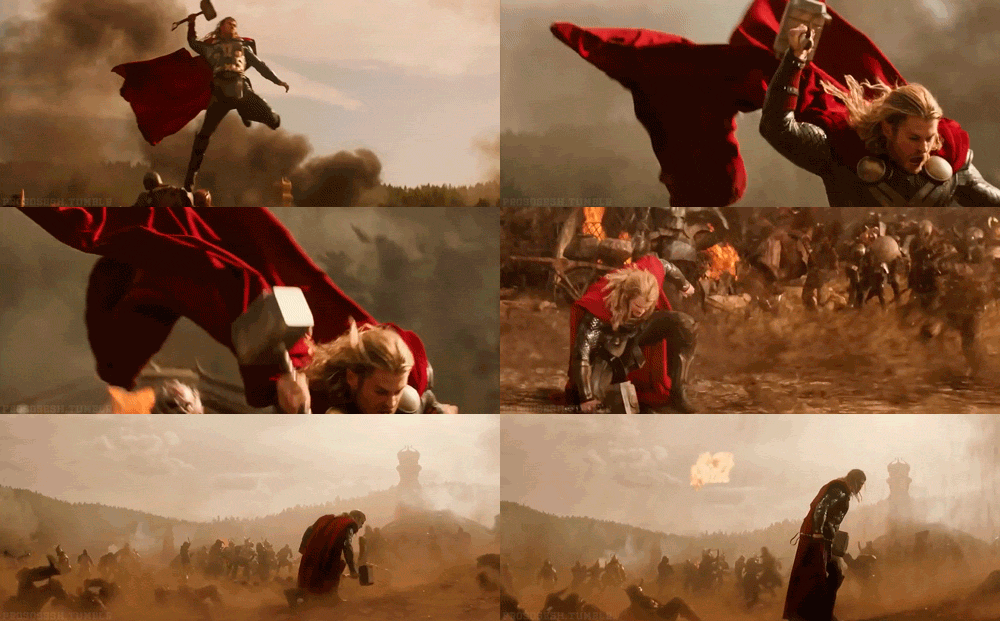
Taylor has limited experience as a movie director, but he has a long history as a television direction. Despite his longer experience with television, I must admit that I found myself more than pleased with his direction of "THOR: THE DARK WORLD". And I was also very impressed. I was especially impressed by his handling of certain action scenes, like the Dark Elves' invasion of Asgard, the fight scene between Queen Frigga and Malekith, the escape from Asgard, and Thor and Loki's confrontation against Malekith and the Dark Elves. But the one action scene that really impressed me turned out to be Thor and Jane's attempt to prevent Malekith's use of the Aether against Earth and the rest of the universe. This scene not only benefited from Taylor's direction, but also Dan Lebental and Wyatt Smith's editing. The movie's action sequences were nicely balanced by some of its dramatic and comedic scenes. I especially enjoyed Thor and Loki's quarrel over the latter's past actions, Thor's reunion with Jane, and Darcy and Ian's attempt to free Erik from a mental institution. One particular scene featured a quarrel between Thor and Odin over how to deal with the threat of the Dark Elves. It strongly reminded me of the two men's quarrel over the Frost Giants in the first film . . . but with an ironic twist. Instead of Odin being the mature and reasonable one, this time it is Thor.
My only complaint about the movie's performances has to do with Tadanobu Asano. Due to his limited appearance in the film, he never really had a chance to give a memorable performance. I hope to see more of him in the next film. Both Jamie Alexander and Ray Stevenson gave competent performances as Thor's two other friends - Lady Sif and Volstagg. Instead of Josh Dallas, this movie featured Zachary Levi in the role of Thor's fourth friend, Fandral. Levi had been originally cast in the role for the 2011 film. But due to his commitments to NBC's "CHUCK", Dallas got the role. But the latter's commitment to ABC's "ONCE UPON A TIME" forced Marvel and Disney to give the role back to Levi. Aside from the initial shock of seeing him in a blond wig, I must admit that Levi made a very dashing Fandral. I was very happy to see Kat Dennings reprise her role of Jane's intern, Darcy Lewis. She was as funny as ever. She also had an extra straight man in the form of Jonathan Howard, who portrayed "her" intern, Ian Boothby. The movie also featured a very funny cameo by Chris Evans, who portrayed Loki disguised as Steve Rogers/Captain America.
Christopher Eccleston may not have made the most witty villain from the Marvel canon, but I found his portrayal of Malekith very scary . . . in an unrelenting way. Adewale Akinnuoye-Agbaje struck me as equally impressive as Malekith's lieutenant, Algrim. It was a pity that I could barely make him out in his new appearance as the Kurse. Renee Russo's role as Queen Frigga was expanded in this second film and I am so thankful that it was. Not only did she have a marvelous dramatic scene with Tom Hiddleston's Loki, but watching her sword fight against Eccleston's Malekith reminded me of her role in the "LETHAL WEAPON" films. Idris Elba repeated his masterful portrayal of Asgard's gatekeeper, Heimdall. I especially enjoyed him in two scenes - Heimdall's efforts to prevent the Dark Elves' attack and his discussion with Thor about helping Jane leave Asgard against Odin's will. More importantly, audiences get to see him in even more scenes. Stellan Skarsgård was very hilarious in his portrayal of Dr. Erik Selvig in this film. I realize that one should not laugh at the idea of someone suffering from a mental trauma, but I could not help it. I do not think I have ever seen Skarsgård so entertaining in a Marvel film. Anthony Hopkins did a marvelous job in conveying Odin's increasing fragile rule over Asgard and control of his emotions. This was especially apparent in the scene featuring Odin and Thor's disagreement over the Dark Elves.
For the first time in a Marvel film, Tom Hiddleston's Loki is not portrayed as an out-and-out villain, but a more morally complex character, thanks to his relationships with Asgard's royal family - especially Thor and Frigga. Hiddleston was as playful and witty as ever. And I especially enjoyed his interactions with Chris Hemsworth. In fact, I can say the same about Natalie Portman's portrayal of Thor's love, astrophysicist Dr. Jane Foster. Personally, I found her funnier and her chemistry with Hemsworth a lot stronger in this second film. And I was especially happy to see her take a more active role in helping Thor defeat the main villain. As for Chris Hemsworth, he continued to roll as the God of Thunder, Thor. He did a marvelous job in developing his character into more complex waters, especially in regard to his relationships with Jane, Loki and Odin. And one of my favorite scenes in the movie featured Thor's silent reaction to his discovery that Jane had a date with another man. I hope that one day, people will truly appreciate what a first-rate actor he can be.
"THOR: THE DARK WORLD" had a few flaws. What movie does not? But thanks to Alan Taylor's direction, an excellent cast led by a talented Chris Hemsworth and a very complex script written by Christopher Yost, Christopher Markus and Stephen McFeely, it not only turned to be very entertaining, but also better than the previous film. At least for me.
"THOR: THE DARK WORLD" (2013) Review
As I had stated in my review of "IRON MAN 3", I had assumed that the release of the 2012 blockbuster, "THE AVENGERS" would signal the end of Marvel's multi-film saga about the group of comic book heroes and their government allies, S.H.I.E.L.D. Not only did "IRON MAN 3" prove me wrong, but also the recent television series, "AGENTS OF S.H.I.E.L.D." and the second movie about the God of Thunder, "THOR: THE DARK WORLD".
Like the 2011 movie, "THOR", this latest film begins thousands of years ago. Back in day (or year); Bor, the father of Odin, clash with the Dark Elves of Svartalfheim and their leader Malekith, who seeks to destroy the universe using a weapon known as the Aether. After conquering Malekith's forces, Bor hides the Aether within a stone column. He was also unaware that Malekith, his lieutenant Algrim, and a handful of Dark Elves have managed to escape by going into suspended animation.
Many years later, Thor and his fellow Asgardians (which include his friends Lady Sif, Fandral and Volstagg) help their comrade Hogun repel marauders on the latter's homeworld, Vanaheim. It proves to be the last battle in a war to pacify the Nine Realms, which had fallen into chaos following the destruction of the Bifröst. And in London, astrophysicist Dr. Jane Foster is led by her intern Darcy Lewis and the latter's intern, Ian, to an abandoned factory where objects have begun to disobey the laws of physics by disappearing into thin air. Jane is teleported to another world, where she is infected by the Aether. Both the Asgardians and Jane's former mentor, Dr. Erik Selvig learn on separate occasions that the Convergence, a rare alignment of the Nine Realms, is imminent. While the event approaches, portals (one of which Jane had fallen into) linking the worlds appear at random. Heimdall alerts Thor of Jane's recent disappearance, leading the latter to search for her on Earth. When she inadvertently releases an unearthly force upon a group of London policemen, Thor takes her to Asgard. Unfortunately, the Asgardian healers do not know how to treat her. Odin, recognizing the Aether, warns Jane's infection will kill her given enough time, and that the Aether's return heralds a catastrophic prophecy. Unbeknownst to Odin, the re-emergence of the Aether also ends the Dark Elves' suspended animation and revives their determination to use the substance to darken the universe.
"THOR: THE DARK WORLD" has proven to be a major box office, since its release nearly a month ago. This is not surprising, considering the enormous success of Marvel's Avenger saga. "IRON MAN 3", set six months after the events of the 2012 film, also proved to be a big hit. Some people have claimed that the first film about Thor was superior. As much as I had enjoyed "THOR", I cannot say that I would agree. It reeked just a bit too much of a superhero origin tale. Personally, I found the plot for "THOR: THE DARK WORLD" more satisfying.
Mind you, this second God of Thunder movie did not strike me as perfect. It had a few flaws. Although I applaud director Alan Taylor and cinematographer Kramer Morgenthau's expansion of the Asgard setting beyond the royal palace and the Bifröst, the latter's photography for that particular setting seemed to lack Haris Zambarloukos' dazzling and colorful photography from the 2011 film. Instead, there seemed to be a slightly dull cast to Morgenthau's photography of Asgard. Thor's friends did not particularly project that same screen chemistry that I found so enjoyable in the first film. Aside from one major scene in which Thor plotted Jane's escape from Asgard, they rarely had any scenes together. And Tadanobu Asano's Hogun had even less scenes. I wonder if this was due to the actor's major role in the upcoming movie, "47 RONIN".
Aside from these nitpicks, I enjoyed "THOR: THE DARK WORLD" very much. As I had earlier stated, I found it more enjoyable than the first film. Thanks to the screenplay written by Christopher Yost, Christopher Markus and Stephen McFeely, the movie provided a stronger narrative, beyond a simple origin tale. The three screenwriters explored the consequences of past events from both "THOR" and "THE AVENGERS" - Loki's actions in both movies; Thor's original destruction of the Bifröst, which led to chaos in the Nine Realms and his long separation from Jane Foster, the latter's inability to move on, and the impact upon Erik Selvig from being possessed by Loki. However, the movie also explored how a past event in the Asgardians' history - their conflict with the Dark Elves - managed to once again, have a negative impact upon Earth. For a movie that was juggling a good number of subplots, along with a major plot, I thought the writers and director Alan Taylor did a first-rate job in balancing it all in the end.
Taylor has limited experience as a movie director, but he has a long history as a television direction. Despite his longer experience with television, I must admit that I found myself more than pleased with his direction of "THOR: THE DARK WORLD". And I was also very impressed. I was especially impressed by his handling of certain action scenes, like the Dark Elves' invasion of Asgard, the fight scene between Queen Frigga and Malekith, the escape from Asgard, and Thor and Loki's confrontation against Malekith and the Dark Elves. But the one action scene that really impressed me turned out to be Thor and Jane's attempt to prevent Malekith's use of the Aether against Earth and the rest of the universe. This scene not only benefited from Taylor's direction, but also Dan Lebental and Wyatt Smith's editing. The movie's action sequences were nicely balanced by some of its dramatic and comedic scenes. I especially enjoyed Thor and Loki's quarrel over the latter's past actions, Thor's reunion with Jane, and Darcy and Ian's attempt to free Erik from a mental institution. One particular scene featured a quarrel between Thor and Odin over how to deal with the threat of the Dark Elves. It strongly reminded me of the two men's quarrel over the Frost Giants in the first film . . . but with an ironic twist. Instead of Odin being the mature and reasonable one, this time it is Thor.
My only complaint about the movie's performances has to do with Tadanobu Asano. Due to his limited appearance in the film, he never really had a chance to give a memorable performance. I hope to see more of him in the next film. Both Jamie Alexander and Ray Stevenson gave competent performances as Thor's two other friends - Lady Sif and Volstagg. Instead of Josh Dallas, this movie featured Zachary Levi in the role of Thor's fourth friend, Fandral. Levi had been originally cast in the role for the 2011 film. But due to his commitments to NBC's "CHUCK", Dallas got the role. But the latter's commitment to ABC's "ONCE UPON A TIME" forced Marvel and Disney to give the role back to Levi. Aside from the initial shock of seeing him in a blond wig, I must admit that Levi made a very dashing Fandral. I was very happy to see Kat Dennings reprise her role of Jane's intern, Darcy Lewis. She was as funny as ever. She also had an extra straight man in the form of Jonathan Howard, who portrayed "her" intern, Ian Boothby. The movie also featured a very funny cameo by Chris Evans, who portrayed Loki disguised as Steve Rogers/Captain America.
Christopher Eccleston may not have made the most witty villain from the Marvel canon, but I found his portrayal of Malekith very scary . . . in an unrelenting way. Adewale Akinnuoye-Agbaje struck me as equally impressive as Malekith's lieutenant, Algrim. It was a pity that I could barely make him out in his new appearance as the Kurse. Renee Russo's role as Queen Frigga was expanded in this second film and I am so thankful that it was. Not only did she have a marvelous dramatic scene with Tom Hiddleston's Loki, but watching her sword fight against Eccleston's Malekith reminded me of her role in the "LETHAL WEAPON" films. Idris Elba repeated his masterful portrayal of Asgard's gatekeeper, Heimdall. I especially enjoyed him in two scenes - Heimdall's efforts to prevent the Dark Elves' attack and his discussion with Thor about helping Jane leave Asgard against Odin's will. More importantly, audiences get to see him in even more scenes. Stellan Skarsgård was very hilarious in his portrayal of Dr. Erik Selvig in this film. I realize that one should not laugh at the idea of someone suffering from a mental trauma, but I could not help it. I do not think I have ever seen Skarsgård so entertaining in a Marvel film. Anthony Hopkins did a marvelous job in conveying Odin's increasing fragile rule over Asgard and control of his emotions. This was especially apparent in the scene featuring Odin and Thor's disagreement over the Dark Elves.
For the first time in a Marvel film, Tom Hiddleston's Loki is not portrayed as an out-and-out villain, but a more morally complex character, thanks to his relationships with Asgard's royal family - especially Thor and Frigga. Hiddleston was as playful and witty as ever. And I especially enjoyed his interactions with Chris Hemsworth. In fact, I can say the same about Natalie Portman's portrayal of Thor's love, astrophysicist Dr. Jane Foster. Personally, I found her funnier and her chemistry with Hemsworth a lot stronger in this second film. And I was especially happy to see her take a more active role in helping Thor defeat the main villain. As for Chris Hemsworth, he continued to roll as the God of Thunder, Thor. He did a marvelous job in developing his character into more complex waters, especially in regard to his relationships with Jane, Loki and Odin. And one of my favorite scenes in the movie featured Thor's silent reaction to his discovery that Jane had a date with another man. I hope that one day, people will truly appreciate what a first-rate actor he can be.
"THOR: THE DARK WORLD" had a few flaws. What movie does not? But thanks to Alan Taylor's direction, an excellent cast led by a talented Chris Hemsworth and a very complex script written by Christopher Yost, Christopher Markus and Stephen McFeely, it not only turned to be very entertaining, but also better than the previous film. At least for me.