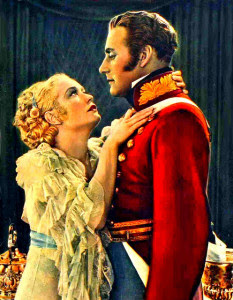
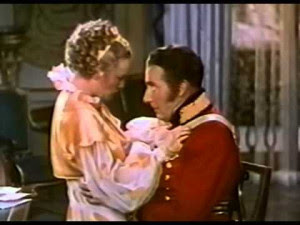
"BECKY SHARP" (1935) ReviewBeing something of a film history buff, I have been aware of the 1935 adaptation of William Makepeace Thackeray's 1847-48 novel, "Vanity Fair" for a number of years. But I have never been inclined to watch the film, until recently. I cannot say what led to my recent interest in "BECKY SHARP". But it was a book on David O. Selznick that made me first aware of the 1935 film. John Hay "Jock" Whitney and Cornelius Vanderbilt Whitney had founded Pioneer Pictures in 1933 as a means to produce color movies. "Jock" Whitney was close friends with Selznick. He even co-financed Selznick's production company, Selznick International, in 1935. Between the creations of Pioneer Pictures and Selznick International, the former released the first feature-length film to use the three-strip Technicolor process. "BECKY SHARP" is the sixth of eleven film and/or television adaptations of the Thackeray's novel. It is the first in color."BECKY SHARP" took its title from the novel's main character, a poor, but educated young English lady who struggles rise in the ranks of Britain's social classes during the early years of the 19th century. Becky Sharp is the orphaned daughter of an English painter and French dancer, who graduates from Miss Pinkerton's Academy for Young Ladies with a friend named Amelia Sedley. Since Amelia is the daughter of a wealthy merchant, Becky manipulates her way into her friend's household, where she meets Amelia's portly and jovial brother, Joseph "Jos" Sedley. Before Becky can sink her hooks into Jos, the Sedley patriarch put an end to the budding "romance" by sending Jos away to India. Meanwhile, Becky finds employment as a governess at the estate of Sir Pitt Crawley. She eventually wins the heart and hand of Crawley's playboy son Rawdon, an officer in the British army. When news of Napoleon Bonaparte's escape from Elba reach Britain, Becky is reunited with Amelia, who has now married her childhood sweetheart George Osborne. The two women's husbands and William Dobbin are deployed to Belgium to face Napoleon's Army. But the last stages of the Napoleonic Wars proved to be the first of many crisis thrown Becky's way. Judging from the movie's title, it is clear to me that screenwriter Francis Edward Faragoh had deleted a great deal of Thackeray's novel in order to write a screenplay with a running time of eighty-four minutes. I found it odd that a film adaptation of such a famous epic novel would have such a short running time. Other epics and movie adaptations of literary works had running times that sometimes went past two hours - including "A TALE OF TWO CITIES", "MUTINY ON THE BOUNTY", "THE CRUSADES", and "CAPTAIN BLOOD". I can only assume that a minor and newly formed production company like Pioneer Pictures could not afford to produce the first Technicolor feature film with a running time close to or over two hours. If that was the case . . . if the Whitneys were that determined to produce the first full-featured movie in color . . . they could have chosen something that was not an adaptation of a famous epic novel. I find it ironic that Mina Nair's 2004 adaptation of Thackeray's novel had received a great deal of criticism for not being truly faithful to its source. I have encountered less criticism of "BECKY SHARP" than I did for the 2004 film. Yet, the latter is more faithful than the former. One of my problems with "BECKY SHARP" is that I thought the producers, director Rouben Mamoulian and screenwriter Francis Edward Faragoh did a piss poor job of adapting Thackery's novel to the screen. I just learned that the 1935 movie is actually an adaptation of Langdon Elwyn Mitchell's 1899 play, which was an adaptation of the 1847-48 novel. I hate to say this, but the movie's running time of eighty-four (84) minutes did not serve the story. There is so much in "BECKY SHARP" that was left out. Most of the narrative that focused upon Amelia was deleted, especially her fractious relationship with her father-in-law, Mr. Osborne. In fact, George's father never made an appearance in this film. I suspect the same could be said about Mitchell's play. The only time the movie focused upon Amelia's character arc was when Becky was personally involved . . . namely George's infatuation with Becky before the Waterloo battle and Becky forcing Amelia to face the truth about George in the movie's last fifteen to twenty minutes. It is not surprising that the movie's title was based upon the main character's name. Not only was much of Amelia's personal story deleted, the movie also rushed through Becky's stay with the Sedley and Crawley families. It seemed as if Mamoulian and Faragoh could not wait to focus on the impact of Waterloo and the marriage between Becky and Rawdon. Between the handling of Amelia's character arc and the rushed narrative in the movie's first half, it is no wonder that I found "BECKY SHARP" particularly unsatisfying.I found other aspects of "BECKY SHARP" unsatisfying. The sound and visual quality of the movie's DVD version low in quality. The photography and color struck me as faded. And the sound is scratchy. For once, I am not blaming the movie's filmmakers. Whoever had possession of "BECKY SHARP" after Pioneer Pictures had failed to maintain its original quality. But I can blame the filmmakers on other aspects of the movie. In it, the Jos Sedley character returned to Europe with a little Indian boy in tow as his personal servant. Only the "Indian servant" was portrayed by a young African-American actor named Jimmy Robinson. To this day, I am still trying to figure out how the producers and director Rouben Mamoulian saw nothing wrong in an African-American kid portraying an Indian kid. Hollywood's casting for non-white characters seemed really skewed in this film. And then . . . there was the acting.I am surprised that "BECKY SHARP" led to a Best Actress Oscar nomination for actress Miriam Hopkins. Granted, she handled the character's questionable morality, desperation and charm very well. Yet, Hopkins engaged in so much hammy acting that I found myself wondering why of all her performances, she ended up earning a nomination for this particular one. I wish I could say that the rest of the cast gave better performances . . . but I cannot. Other cast members gave equally hammy performances. Nigel Bruce, Alan Mowbray, Alison Skipworth, G.P. Huntley and many others were equally hammy. I could not accuse Colin Tapley of hamminess on the same scale. But I found his portrayal of William Dobbin rather dramatic. And I am not being complimentary. The only cast members who actually impressed me were Frances Dee and Cedrick Hardwicke. Dee gave a surprisingly subtle and convincing performance as the sweet and passive Amelia Sedley. Thanks to Dee's performances, audiences saw both the positive and negative aspects of Amelia's passiveness. Hardwicke was equally subtle as Becky's aristocratic "benefactor", the Marquis of Steyne. Even though Steyne is an unlikable character, Hardwicke was no mustache-twirling villain. The only reason I would recommend "BECKY SHARP" to anyone is for historical purposes. Because this is the first feature-length motion picture in color, I would recommend this movie to any film buff. Otherwise, I would stay clear of "BECKY SHARP" and consider other adaptations of William Makepeace Thackery's novel.

"PRIDE AND PREJUDICE" (1995) Review
There have been numerous adaptations of Jane Austen’s celebrated 1813 novel, "Pride and Prejudice" over the past decades. Two of these versions happened to be BBC miniseries that aired in 1980 and 1995. It has been a long time since I have viewed the 1980 miniseries. However, I recently saw the 1995 miniseries for the umpteenth time and decided to finally write a review of it. Adapted by screenwriter Andrew Davies, the miniseries was produced by Sue Birtwistle and directed by Simon Langton.
Austen’s story centered around one Elizabeth Bennet, the second of five daughters of a country gentleman living in Regency England and the efforts of her parents (or should I say of her mother) to find eligible husbands for her and her four other sisters. Two of these men happened to be the wealthy Charles Bingley, who has moved into the Bennets’ Hertfordshire neighborhood; and his wealthier friend, Fitzwilliam Darcy. The cheerful Mr. Bingley has managed to easily win the favor of the Bennets and their neighbors. He has also fallen in love with Elizabeth’s older sister, the even-tempered Jane. On the other hand, the more reticent Mr. Darcy not only managed to alienate Elizabeth, the other Bennets and the entire neighborhood with his aloof manner, but also fall in love with Elizabeth. "PRIDE AND PREJUDICE", more than anything, focused upon the volatile love story between Elizabeth and Mr. Darcy.
Like nearly every other work of art in existence, ”PRIDE AND PREJUDICE” has its share of flaws. Years after I first saw this miniseries, I still find myself wincing at actress Alison Steadman’s portrayal of the boorish Mrs. Bennet. I realize that the character possessed a wince-inducing personality. But there seemed to be a shrill note in Steadman’s performance during the miniseries’ first episode that made her portrayal of Mrs. Bennet seemed over-the-top. Another complaint I have about the miniseries is the lack of complexity in supporting characters like Elizabeth’s aunt and uncle – Mr. and Mrs. Gardiner – and Darcy’s sister, Georgiana. I found all three very likeable, but also slightly boring. They were the only characters that seemed to indulge in banal conversation that complimented everyone and everything.
I have two problems regarding the crisis over Lydia Bennet’s elopement with George Wickham, Darcy’s boyhood companion. One, I never understood why a calculating scoundrel like Wickham would bother to leave Brighton with Lydia in tow, on the promise of elopement. He knew that her family did not have the funds to buy him off. And I have read excuses, which explained that Wickham left Brighton because he had accumulated a good deal of debt during his regiment’s stay. I have also read that he took Lydia with him as an excuse to get out of town. With the promise of elopement? That does not sound right. Wickham was not a fool. It was bad enough that he had accumulated debts and had to get out of Brighton. But to drag Lydia in this mess did not strike me as logical. All he had to do was leave town in the middle of the night. Whether he was with Lydia or by himself, he ended up being absent without leave. I cannot help but wonder if Austen ever thought this through when she wrote her novel. The elopement crisis also forced Elizabeth to end her summer tour of Derbyshire with the Gardiners and return to her family at Longbourn. For the next twenty minutes or so, ”PRIDE AND PREJUDICE” grounded to a halt, while the Bennets received a series of correspondence and visitors. This sequence featured two scenes of a bored Lydia and an anxious, yet frustrated Lydia sharing a rented room in London, and two featuring Darcy’s search for the pair. This sequence also featured a meaningless visit from Mr. Collins in which he smirked over the family’s possible ruination for less than five minutes. These little scenes failed to help the sequence move at a faster pace.
Before one starts to assume that I do not like ”PRIDE AND PREJUDICE”, let me make it clear that I enjoyed it very much. In fact, I absolutely adore it. Not only is it one of my favorite Jane Austen adaptations of all time, it is one of my top ten favorite miniseries of all time. Yes, it has its flaws. Even some of the best movies and television productions have flaws. And as I have pointed out, I do believe that the 1995 miniseries is no exception. But its virtues definitely outweighed the flaws. The miniseries’ five-and-a-half hours running time proved to be more of a virtue than a hindrance. But the miniseries format allowed viewers to enjoy this adaptation at a more leisurely pace than is allowed in a movie adaptation and the rich details of the story. I have seen at least five versions of Austen’s ”Pride and Prejudice”. I have noticed that the plots for two of the movie versions went into great detail of the novel’s first half – from the Bingleys and Darcy’s arrival in Hertfordshire to Darcy’s first proposal to Elizabeth in Kent. But after that first proposal, the movie versions seemed to zoom ahead to Lady Catherine de Bourgh’s visit to Longbourn. I cannot say the same for the two television versions I have seen – especially the 1995 version. Aside from the tedious “search for Lydia” sequence, the story’s second half proved to be quite entertaining – especially Elizabeth’s visit to Derbyshire, Lydia and Wickham’s visit to Longbourn as a married couple, along with Darcy and Bingley’s efforts to renew their pursuits of the two elder Bennet sisters.
It could be understandable that the movie adaptations seemed to focus more on the novel’s first half. After all, many consider it to be the best part. The Bennets’ encounters with Darcy and the Bingleys crackled with energy and great humor. The series of fascinating verbal duels between the two lead characters possessed that same energy, along with a great deal of sexual tension. And when one throws the obsequious and ridiculous Mr. Collins into the mix, one has the feeling of watching a comedy-romantic masterpiece. All of this humor, energy and romance, mixed in with an elegant setting seemed to be at an apex in the Netherfield ball sequence. Personally, I consider the dance shared warily between Elizabeth and Darcy to be one of the best written and filmed scenes in the entire miniseries. Another scene that many consider to be one of the best, featured Darcy’s first marriage proposal to Elizabeth, during her visit to Charlotte and Mr. Collins at Hunsford Lodge, in Kent. That particular scene has to be one of the most wince-inducing moments in the entire story. Why? Because I found it hard to watch Elizabeth receive that extra-ordinary marriage proposal laced with passion . . . and slightly insulting remarks about her family background on her mother’s side. And because I found it difficult to watch Darcy endure Elizabeth’s heart stomping rejection. Both Jennifer Ehle and Colin Firth performed the hell out of that scene.
Speaking of performances, one of the miniseries’ greatest assets was its cast. Jane Austen wrote a novel filled with some rich supporting characters. Director Simon Langton and screenwriter Andrew Davies utilized them very well. And so did the cast. Now, I cannot take back my complaints regarding Alison Steadman’s performance as Mrs. Bennet in the first hour. Yet shrill or not, she managed to capture her character’s personality perfectly. And so did Benjamin Whitrow, who portrayed the sardonic and long suffering Mr. Bennet. Some fans of Austen’s novel have complained about David Bamber’s buffoonish take on Mr. Collins, the Bennet’s obsequious cousin fated to inherit Longbourn upon Mr. Bennet’s death. But my memories of the literary Mr. Collins were that of a buffoonish man. However, Bamber gave his Mr. Collins a brief, poignant moment when Elizabeth took pity on his efforts to hide his slightly damaged pride with a tour of Hunsford. Julia Sawalha did a superb job in her portrayal of the youngest Bennet sibling – the thoughtless and self-centered Lydia. In fact, Sawalha managed to give one of the funniest performances in the entire miniseries. However, she had some stiff competition from the likes of Polly Maberly, who portrayed the slightly less flighty Kitty Bennet; and Lucy Briers, who portrayed the bookish and slightly self-righteous Mary Bennet.
One of the memorable performances in the miniseries came from actress Anna Chancellor, who portrayed one of Charles Bingley’s annoying and snobbish sister, Caroline. Chancellor managed to convey not only Caroline’s pretentious and spiteful sense of humor very well, but also the character’s desperate attempts to woo an uninterested Mr. Darcy. I believe that Crispin Bonham-Carter did a good job in infusing his character, Charles Bingley, with a good deal of bohemian warmth and cheerfulness. Yet, he had a tendency to read his lines in a broad manner that struck me as a bit too theatrical at times. I must admit that he could be very subtle in conveying Bingley’s attempts to suppress negative reactions to certain members of the Bennet family and his two sisters. Superficially, Susannah Harker’s performance as Jane Bennet seemed solid . . . almost dull. But a closer look at the actress’s performance made me realize that her she did a much better job in the role than most people were willing to give her credit for. She was excellent in conveying Jane’s heartbreak over the separation from Mr. Bingley. And she had one truly hilarious moment during the Netherfield Ball, when her character anxiously pointed out Mr. Collins’ intentions to speak to Mr. Darcy. But more importantly, Harker’s Jane seemed more like an older sister than the performances of the other actresses who had portrayed the role.
If I have to cite what I consider to be the three best performances in ”PRIDE AND PREJUDICE”, they would be Adrian Lukis as George Wickham, Colin Firth as Fitzwilliam Darcy, and Jennifer Ehle as Elizabeth Bennet. In my opinion, Lukis’ portrayal of the charming and devious wastrel, George Wickham, is the best I have seen by any actor who has portrayed the role. I would not claim that he was the best looking Wickham. But Lukis conveyed a seamless charm that hinted a heady mixture of warmth, false honesty, and intimacy that could make anyone forget that his Wickham was a man one could not trust. And the actor achieved this with a subtle skill that made the other Wickhams look like amateurs.
Many fans and critics have labeled Colin Firth’s portrayal of Fitzwilliam Darcy as “smoldering” or “sexy” . . . worthy of a sex symbol. I do not know if I would agree with that assessment. What many saw as “smoldering”, I saw a performance in which the actor utilized his eyes to convey his character’s emotional responses. Whether Firth’s Darcy expressed contempt toward others, growing love and desire for Elizabeth Bennet, anxiety, wariness or any other emotion; Firth uses his eyes and facial expressions with great skill. Some fans have complained that his Darcy appeared in too many scenes in the last third of the series. I consider this nothing more than an exaggeration. Personally, I enjoyed those little sequences in which Firth revealed Darcy’s struggles to deal with Elizabeth’s rejection. While several others drooled over Firth in a wet shirt and breeches, I enjoyed the awkwardness in the reunion between his Darcy and Elizabeth. Firth earned an Emmy nomination for his portrayal of the complex and reserved Mr. Darcy. And as far as I am concerned, he certainly deserved it . . . and a lot more.
Jennifer Ehle won a BAFTA award for her portrayal of Elizabeth Bennet, the vivacious leading lady of ”PRIDE AND PREJUDICE”. And it was a well deserved award, as far as I am concerned. Ehle not only formed a sizzling screen chemistry with Colin Firth, but with Adrian Lukis, as well. And like the two actors, she put her own stamp on her role. Ehle perfectly captured the aspects of Elizabeth’s character that many fans have admired – her liveliness, intelligence, warmth and sharp wit. Elizabeth’s habit of forming and maintain first opinions of others have been well-documented, which Ehle managed to capture. She also conveyed another disturbing aspect of Elizabeth’s personality – namely her arrogance. In some ways, Ehle’s Elizabeth could be just as arrogant as Mr. Darcy. She seemed to harbor a lack of tolerance toward those she viewed as flawed individuals. And thanks to Ehle’s skillful performance, this arrogance is conveyed in Elizabeth’s wit, barely suppressed rudeness and unwillingness to listen to good advice about making fast judgment about others from two people she highly admired – her sister Jane and her good friend, Charlotte Lucas.
The most important thing I can say about both Ehle and Firth is that the pair managed to form a sizzling screen chemistry. In other words, their Elizabeth and Mr. Darcy crackled with a great deal of energy, subtle sexuality and sharp wit. Their screen chemistry seemed stronger than any of the other screen couples who have portrayed the two characters. Surprisingly, I do have one problem with the two leads in the miniseries. And I have to place all of the blame on Andrew Davies, when he decided to faithfully adapt one scene in which the newly engaged Elizabeth and Mr. Darcy discussed the development of their relationship. Unfortunately, they came off sounding cold and clinical – like two psychoanalysts examining the genesis of their romance.
There is no doubt that producer Sue Birtwistle, director Simon Langton and the production team did a superb job with the miniseries’ overall production design. Mind you, I feel that the overall credit belonged to production designer Gerry Scott and art designers John Collins and Mark Kebby. They did a top notch job in capturing Austen’s tone from the novel by giving the miniseries a light and natural look to its setting. I could say the same for cinematographer John Kenway’s photography. I am not claiming to be an expert on the fashions of Regency Britain. Yet, from what I have read in other articles, many believed that Dinah Collin’s costumes closely recaptured the fashion and styles of the period when the novel was first published. I could not make final statement about that. But I must admit that the fashions perfectly captured the tone of the story and the production designs. If there is one other aspect of the miniseries that reflected its look and tone, I believe it would have to be Carl Davis’ score. Either he or Birtwistle made the right choice in hiring pianist Melvyn Tan to perform the score for the series’ opening credit.
In the end, ”PRIDE AND PREJUDICE” became one of the most acclaimed miniseries on both sides of the Atlantic. Even after nineteen years, it is still highly regarded. And rightly so. Despite a few flaws, I believe it deserves its accolades. As far as I am concerned, the 1995 miniseries remains to be the best adaptation of Jane Austen’s 1813 novel. I also believe it is one of the best adaptations of any Austen novel, period.