Showing posts with label julia mckenzie. Show all posts

Wednesday, July 1, 2020

"THE SECRET OF CHIMNEYS" (2010) Review

926118_original


"THE SECRET OF CHIMNEYS" (2010) Review

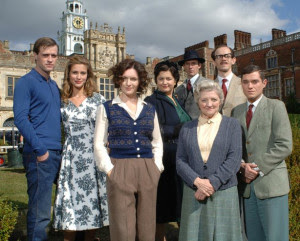
Anyone who has read Agatha Christie's 1925 novel, "The Secret of Chimneys", will be disappointed by the 2010 television adaptation that stars Julia McKenzie as Miss Jane Marple. The television movie bears little resemblance to the novel. But that does not mean one should completely dismiss the movie. 

Although a long time fan of Christie's novels, I have never read "The Secret of Chimneys". Familiar with many of the author's novels, I knew that the former was not one that featured Jane Marple. I did not care. I have come across other Miss Marple television movies in which the literary source did not feature her as the main character. However, I was surprised to learn that the 2010 movie bore very little resemblance to the original novel. Then again, I should not have been surprised. The forces behind the adaptations of Christie novels seemed to have a penchant for changing the plots and sometimes, even the murderer's identities, whenever the whim struck them. And this whim certainly went into full gear for"THE SECRET OF CHIMNEYS".

Written by Paul Rutman, the plot for "THE SECRET OF CHIMNEYS" begins in the 1930s, when an Austrian named Count Ludwig Von Stainach first visited Chimneys, the estate of the 9th Maquis of Caterham to attend a diplomatic ball. During that visit, a famous diamond belonging to Lord Caterham, is stolen; leading to the beginning of the decline of his family's fortunes. Over twenty years later, Jane Marple, who is related to Lord Caterham's family, visits Chimneys for a weekend house party when she learns that it is being considered to become a part of National Trust. Also attending the house party held by Lord Caterham is a local ambitious Member of Parliament (M.P.) named George Lomax, who wants to marry the aristocrat's younger daughter, Lady Virginia Brent; older daughter Lady Eileen "Bundle" Brent, and National Trust advocate Miss Hilda Blenkinsopp. However, the main reason behind the house party proves to be the visiting Count Von Stainach, whom Lomax wants Lord Caterham to entertain in order to sign a deal for iron ore that post-World War II England desperately needs. Unbeknownst to everyone else, Lady Virginia has met and fallen in love with a young man named Anthony Cade, who has decided to crash the party in order to prevent her from marrying Lomax. However, the house party takes a dark turn when someone shoots and kills Count Von Stainach in one of the manor's secret passages. And since Anthony was the first to stumble across the count's body, he becomes "Suspect Number One".

Knowing that "THE SECRET OF CHIMNEYS" was not an original Jane Marple mystery, I had no idea on what to expect from this television series. Thankfully, the movie proved to be a surprisingly entertaining film filled with some humor, strong characterizations, plenty of romance - both charming and poignantly sad, and two very puzzling mysteries. Although one mystery surrounded the disappearance of the Brents' diamond and the other featured the murder of Count Von Stainach, both proved to be connected to one another. I have read the synopsis of Christie's 1925 novel. I must admit that it read more like a political thriller than a murder mystery. And a part of me felt somewhat relieved that screenwriter Rutman did not attempt a faithful adaptation of the novel. Some have claimed that Anthony Cade, who was featured as the main investigator in the novel, had been pushed into the background. I cannot agree with this assessment. Instead of the story's main investigator, Cade was used as one half of the movie's main love story and the main suspect of Von Stainach's murder. Rutman did a very good job in utilizing the Cade character, while replacing him with Miss Marple as the main investigator.

There were technical aspects of "THE SECRET OF CHIMNEYS" that I certainly enjoyed. Chris Seager's photography struck me as beautiful. The movie's photography displayed its filming locations - Hatfield House for the exterior shots andKnebworth House for the interior shots - with beautifully sharp colors. Miranda Cull contributed to Seager's photography with her art designs for the movie's interiors shot inside Knebworth House. And Sheena Napier did an excellent job of designing costumes for the movie's characters. This is a movie filled with upper-class or aristocratic characters who have seen better times, financial. This means that Napier's costumes had a mid-century elegance that seemed slightly worn, and did not come off as expensively glamourous.

Charlotte Salt, Jonas Armstrong, Ruth Jones and Matthew Horne. Anthony Higgins, whom I have not laid eyes upon in years, gave a charming performance as the elegant, yet extroverted Count Ludwig Von Stainach. But there were performances that really caught my eye. One of them came from Stephen Dillane, who gave a deliciously twisted performance as the slightly eccentric Scotland Yard Chief Inspector Fitch. Another performance that impressed me came from Adam Godley, whom I last saw on USA Network's "SUITS". I thought he perfectly portrayed the ambitious, yet controlling politician George Lomax. I rather liked Dervla Kirwan's portrayal of Lady Eileen "Bundle" Brent, Lord Caterham's older daughter. I felt Kirwan did an excellent job in portraying a woman who is struggling to deal with the possible erosion of a lifestyle she had known all of her life. Edward Fox is another I have not seen in years. But I felt that he, along with Dillane and Julia McKenzie gave the best performances in the movie. Fox's Maquis of Caterham proved to be a skillful portrayal of an elderly, yet sad man whom seemed unable to stop grieving over a recently deceased wife. 

Julia McKenzie has received some criticism for her portrayal of Jane Marple over the past three to four years. Apparently, many fans believe she seemed a bit too robust and young to be portraying the elderly sleuth. McKenzie, who is in her early 70s, is old enough. And quite frankly, I have enjoyed her portrayal just as much as I have Joan Hickson and Geraldine McEwan's. McKenzie simply has a different, slightly less incoherent style in approaching the Miss Marple character. And not only did I enjoyed it in "THE SECRET OF CHIMNEYS", but also in her other Miss Marple movies. 

I would not exactly view "THE SECRET OF CHIMNEYS" as one of the best Miss Marple mysteries I have seen on television. But thanks to some solid direction from John Strickland, a surprisingly first-rate script written by Paul Rutman and some superb performances from a cast led by Julia McKenzie, I ended enjoying it very much.

Thursday, March 26, 2015

"RETURN TO CRANFORD" (2009) Review


"RETURN TO CRANFORD" (2009) Review

Due to the success of the 2007 miniseries, "CRANFORD", the BBC aired a two-part sequel called "RETURN TO CRANFORD" (also known as the "CRANFORD CHRISTMAS SPECIAL"), some two years later. Like the original miniseries, it was adapted by Heidi Thomas and directed by Simon Curtis. 

"RETURN TO CRANFORD" was based on material from Elizabeth Gaskell’s two novellas and a short story - "Cranford","The Mooreland Cottage", and "The Cage at Cranford", were all published between 1849 and 1863. Also, themes from"My Lady Ludlow""Mr. Harrison's Confessions", and "The Last Generation in England" were included to provide continuity with the first miniseries. The new miniseries took place between August and December 1844. The citizens of Cranford find themselves facing major changes in their society, as the railroad continues to be constructed near the edge of town. In fact, I was surprised to learn that a great deal of the story surrounding the new railroad was not in any of Gaskell’s novellas and short story. Only the storylines featuring about Mrs. Jameson’s (Barbara Flynn) cousin, Lady Glenmire (Celia Imrie) and Captain Brown (Jim Carter), Miss Pole’s (Imelda Staunton) Parisian “cage” for her pet cockatoo, and a magician named Signor Brunoni (Tim Curry) putting on a show came from Gaskell’s works. 

I have to be frank. It did not bother me that most of the material featured in the miniseries did not come from any of Gaskell’s novellas and short stories. Thanks to some decent writing by Heidi Thomas, I believe that it all worked out fine. Unlike the 2007 miniseries, "CRANFORD", the screenplay for "RETURN TO CRANFORD" seemed tighter and more focused. In fact, I noticed that the majority of major storylines featured in the miniseries have ties to the main story about the railroad’s construction. Because of this, "RETURN TO CRANFORD" avoided the episodic style of storytelling that I believe marred "CRANFORD". My favorite storyline featured the budding romance between two newcomers to the town of Cranford – William Buxton (Tom Hiddleston), the Eton-educated son of a salt baron (Jonathan Pryce) and Peggy Bell (Jodie Whittaker), the daughter of a less-affluent widow (Lesley Sharp). Mr. Buxton wants William to marry his ward, the Brussels-educated Erminia (Michelle Dockery). But neither are interested in each other. And Peggy has to deal with her ambitious and greedy brother, Edward (Matthew McNulty), who dislikes William. What I liked best about"RETURN TO CRANFORD" was that most of the storylines were tied to the new rail line being constructed near Cranford - even the William/Peggy romance.

As much as I hate to admit it, "RETURN TO CRANFORD" had its problems. Another storyline featured the problematic pregnancy suffered by Miss Matty’s maid, Martha Hearne (Claudie Blakley). The problem arose, due to the lack of doctors in Cranford. And I found this confusing. The 2007 miniseries ended with two doctors residing in the town – the recently married Dr. Frank Harrison and longtime resident Dr. Morgan. A year later, both no longer resided in Cranford and Heidi Thomas’ script never revealed their whereabouts or fate. Thomas’ real misstep featured the death of Lady Ludlow (Francesca Annis) and the arrival of her ne’er-do-well son, Septimus (Rory Kinnear). The latter’s attempt to cheat young Harry Gregson (Alex Etel) out of the money he had inherited from the late Mr. Carter was a poorly conceived and written storyline. And despite the built-up, it failed to have any real impact upon the Harry Gregson character, due to its vague ending. As much as I found Signor Brunoni’s Christmas show rather charming, I thought it also reeked of a sentimentality that made my teeth hurt. Especially when Miss Matty’s reunion with Jem Hearne (Andrew Buchan) and his daughter entered the picture.

The production design for "RETURN TO CRANFORD" was top notch as ever. And Alison Beard’s supervision of the costumes proved to be just as first-rate as Jenny Beavan’s work in the 2007 miniseries. The cast continued its first-rate work from the previous miniseries – especially Judi Dench as Miss Matty Jenkyns, Imelda Staunton as town gossip Octavia Poole, Francesca Annis as the aristocratic Lady Ludlow, Emma Fielding as her assistant Laurentia Galindo, Alex Etel as Harry Gregson, Julia McKenzie as Mrs. Forrester, Jim Carter as Mr. Brown, Alex Jennings as the Reverend Hutton and Barbara Flynn as the pretentious Mrs. Jamieson. But the newcomers that impressed were Tom Huddleston as William Buxton, Jonathan Pryce as the tyrannical Mr. Buxton, Jodie Whittaker as Peggy Bell, Celia Imrie as the earthy Lady Glemire and Tim Curry as the warm-hearted magician Signor Brunoni.

For a while, I had been reluctant to watch "RETURN TO CRANFORD". Because it was a sequel to the 2007 miniseries, I figured that it could never be as good as "CRANFORD". I was wrong. I do not know if I would consider it better than the first miniseries. But the latter is certainly not better than the sequel. And ”RETURN TO CRANFORD” does have one major advantage . . . namely Heidi Thomas’ screenplay turned out to be more tightly written, due to her decision not to use much of Elizabeth Gaskell’s material. Personally, I find that rather ironic.

Sunday, February 22, 2015

"RETURN TO CRANFORD" (2009) Photo Gallery


Below are images from "RETURN TO CRANFORD", the 2009 sequel to the 2007 miniseries, "CRANFORD". Judi Dench starred in this two-part series: 


                                        "RETURN TO CRANFORD" (2009) Photo Gallery


Friday, March 30, 2012

"CRANFORD" (2007) Review


"CRANFORD" (2007) Review

Three years ago, the BBC aired a five-part miniseries adaptation of Elizabeth Gaskell’s series of stories about a small town in North West England. After viewing the 2004 miniseries, "NORTH AND SOUTH", my curiosity regarding the 2007 miniseries became piqued and I turned my attention toward it.

Created by Sue Birtwistle and Susie Conklin, directed by Simon Curtis and Steve Hudson, and adapted by Heidi Thomas; "CRANFORD" is based upon three of Gaskell’s novellas published between 1849 and 1858 - "Cranford", "My Lady Ludlow", and "Mr Harrison's Confessions". Birtwistle, Conklin and Thomas took aspects of Gaskell’s stories, re-shuffled them and added some of their own plotlines to create the five-episode miniseries. "CRANFORD" mainly focused upon the small English village between 1842-1843, during the early years of the Victorian Age. On the surface, Cranford seemed like an idyllic community in which time remained stuck in the late Georgian Age. However, progress – both technological and social – began its intrusion upon the community for better or worse. The arrival of a young doctor named Frank Harrison with modern new ideas about medical practices, and a railway construction crew on the town’s outskirts that meant the arrival of the railway, change and possibly unwelcomed citizens; seemed to be the prime symbols of the encroaching Industrial Age.

Many humorous and tragic incidents shown as minor plotlines are scattered throughout "CRANFORD". But the main stories seemed to focus upon the following characters:

*Miss Matilda “Matty” Jenkyns – the younger of two elderly sisters who had to endure a series of travails that included the death of a loved one, the reunion with an old love and the loss of her income.

*Dr. Frank Harrison – Cranford’s new young doctor who has to struggle to win the trust of Cranford’s citizens and the love of the vicar’s oldest daughter, Sophy Hutton.

*Lady Ludlow – the Lady of Hanbury Court who struggles to maintain funds for her spendthrift son and heir living in Italy.

*Mr. Edmund Carter – Lady Ludlow’s land agent, who views Lady Ludlow’s attempts to raise funds for her dissolute son with a leery eye and clashes with his employer over the fate of the young son of a poacher.

*Harry Gregson – the very son of the poacher, whom Mr. Carter views as promising and whom Lady Ludlow views as someone who should remain in his station.

*Octavia Pole – a spinster and Cranford’s town gossip who proves to be the subject of a series of hilarious events.


I realize that ”CRANFORD” is a highly acclaimed program. And I also understand why it became so popular. The production team for "CRANFORD" did an excellent job in conveying television viewers back in time to the early Victorian Age. The miniseries possessed some very whimsical moments that I found particularly funny. These moments included Miss Deborah Jenkyns’ assistance in helping Miss Jessie Brown and Major Gordon stay in beat during their rendition of ”Loch Lomond” with a spoon and a teacup; Miss Pole’s hysteria over a thief in Cranford; Caroline Tomkinson’ infatuation with Dr. Harrison; and especially the incident regarding the cat that swallowed Mrs. Forrester’s valuable lace.

Yet, ”CRANFORD” had its poignant moments. Dr. Harrison’s futile efforts to save young Walter Hutton from the croup, along with Miss Deborah Jenkyns’ death allowed Episode 2 to end on a sober note. And the doctor's more successful efforts to save Sophy Hutton from typhoid gave the last episode a great deal of drama and angst. I found it almost difficult to watch Miss Matty endure one crisis after another – until she finally prevailed with the establishment of her own tea shop, with the help of the ladies of Cranford and her reunion with her long lost brother. My heartstrings also tugged when the conflict between Mr. Carter and Lady Ludlow over Harry Gregson ended on a tragic, yet poignant note. But the one scene that left me in tears turned out to be the series’ final shot of Cranford’s citizens bidding good-bye to the recently married Dr. Harrison and Sophy. The miniseries closed on what seemed to be a real sense of community.

And that is what the theme of ”CRANFORD” seemed to be about – at least to me. Community. However, this theme and the Gaskell novellas that the miniseries were based upon have led me to a conclusion. There seemed to be a lack of balance or blending between the series’ format and the material. If ”CRANFORD” had been based upon one novel or a series of novels that served as a continuing saga, I would never have any problems with its tight structure of a five-episode miniseries. But ”CRANFORD” was based upon three novellas written over a period of time that were certainly not part of a continuing saga. And if I must be frank, I personally feel that the miniseries could have served its source of material a lot better as a one or two-season television series.

I realize that producing a television series that was also a period drama would have been more expensive than a miniseries or a series set in the present. But Heidi Thomas’ script seemed vague for the miniseries format. With the exception one particular storyline, ”CRANFORD” seemed to be filled with minor stories that were usually resolved within one to three episodes. For example, the Valentine card storyline that left Dr. Harrison in trouble with the ladies of Cranford stretched across three episodes. Even the railway construction storyline only appeared in three episodes and not in any particular order. Miss Matty’s financial situation only stretched into two episodes. And plots featuring the lace-swallowing cat, Miss Matty’s relationship with Mr. Thomas Holbrook, and Jem Hearne’s broken arm only appeared in one episode. The only storyline that consistently appeared in all five episodes turned out to be the conflict between Lady Ludlow and Mr. Carter over Harry Gregson’s future.

But one cannot deny that ”CRANFORD” was blessed with a first-rate cast. The cream of this cast consisted of a sterling group of veteran British actresses, whose characters dominated the series. However, only a handful of performances really caught my attention. Two of them belonged to Judi Dench and Eileen Atkins as the Jenkyns sisters – the mild-mannered Matty and the domineering Deborah. Judging from their outstanding performances, I can easily understand how one of them earned an Emmy nomination for Outstanding Lead Actress and the other won both an Emmy and a BAFTA for Outstanding Lead Actress. Another outstanding performance from a veteran actress came from Francesca Annis, who portrayed the intensely conservative Lady Ludlow. Annis did a wonderful job in conveying her character’s rigid opposition to education for the lower classes and struggle to overcome these feelings in the face of her kindness and compassion. Philip Glenister, who made a name for himself in the 1995 miniseries ”VANITY FAIR” and in the award winning series ”LIFE ON MARS” and its sequel, "ASHES TO ASHES"; certainly proved his talents as an actor and strong screen presence in his portrayal of the intense, yet very practical Mr. Edmund Carter. I especially enjoyed Glenister’s scenes with Annis, while their characters clashed over the fate of young Harry Gregson. Providing the bulk of comic relief were actresses Imelda Staunton (from 1995’s "SENSE AND SENSIBILITY" and "HARRY POTTER AND THE ORDER OF THE PHOENIX") and Julia McKenzie (the new Miss Jane Marple for ITV). They portrayed two of Cranford’s biggest gossips, Miss Octavia Pole and Mrs. Forrester. Staunton seemed truly hilarious, while portraying Miss Pole’s terror and anxiety over becoming the victim of a thief. And not only was McKenzie funny as the finicky Mrs. Forrester, she gave a poignant soliloquy in which her character recalled a past act of kindness from Miss Matty.

In conclusion, I really enjoyed "CRANFORD". Thanks to directors Simon Curtis and Steve Hudson, along with production designer Donal Woods, screenwriter Heidi Thomas and costume designer Jenny Beavan; the miniseries gave television audiences a warm, humorous and poignant look into village life in early Victorian England. But despite the production team and the cast, I believe the miniseries has a major flaw. Its source material – three novellas written by Elizabeth Gaskell – did not mesh very well with the miniseries format. I believe that "CRANFORD" would have been better off as a television series. Such a format could have served its stories a lot better.

Sunday, February 12, 2012

"CRANFORD" (2007) Photo Gallery


Below is a gallery of photos from the 2007 award-winning miniseries based upon three of Elizabeth Gaskell's novellas - "Cranford", "My Lady Ludlow", and "Mr Harrison's Confessions". Directed by Simon Curtis and Steve Hudson, the five-part miniseries' cast includes Simon Woods, Judi Dench, Eileen Atkins, Imelda Staunton and Michael Gambon:


"CRANFORD" (2007) Photo Gallery