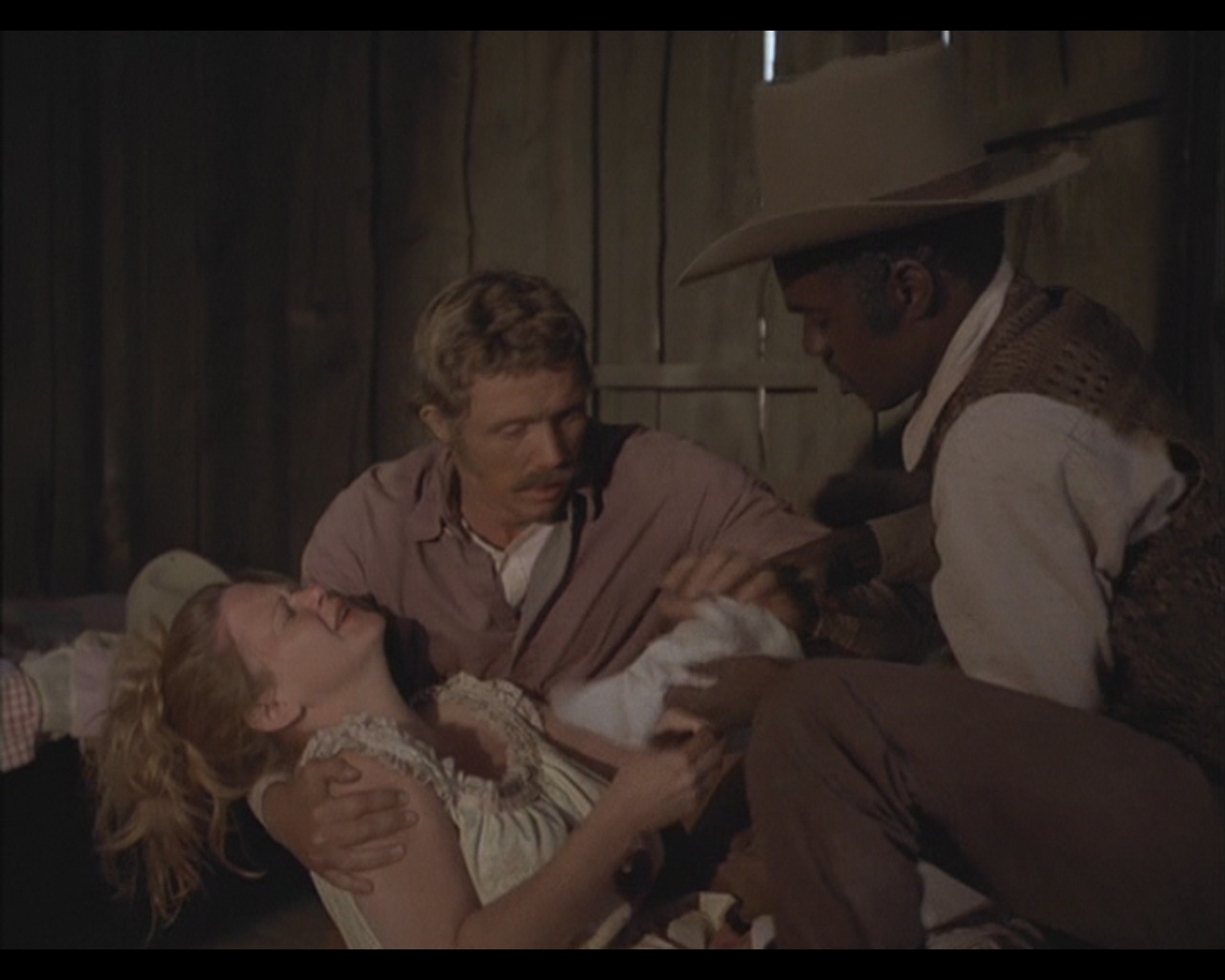
"CENTENNIAL" (1978-79) - Episode Ten "The Winds of Fortune" Commentary
This tenth episode of "CENTENNIAL" called "The Winds of Fortune" marked the last one set in the 19th century. The episode also featured the end of several story lines - the troubles with the Pettis gang, Axel Dumire's suspicions of the Wendell family, Hans Brumbaugh's labor problems and Jim Lloyd's romantic problems with Charlotte Seccombe and Clemma Zendt.
The range war that the ranchers began in "The Shepherds" finally gasped its last breath in this episode. The last remnants of the Pettis gang (the killers hired by the ranchers to get rid of the farmers and shepherds) make one last attempt to exact revenge against Amos Callendar, Jim Lloyd and Hans Brumbaugh - the three men who had killed Frank and Orvid Pettis in revenge for the deaths of two friends. Naturally, it failed during a gunfight against Jim, Amos and the latter's son.
The Pettis gang's revenge attempt also led to the closure of the story line that featured Sheriff Axel Dumire and the Wendell family. The gunfight at Amos' homestead allowed one Pettis killer to escape back to Centennial . . . but not for long. Dumire led a manhunt for the escaped killer. And in a dark alleyway, he and the Pettis outlaw mortally shot each other. While the outlaw died right away, Dumire suffered a slow death. Before expiring, he summoned young Philip Wendell for a last attempt to learn the truth about the now dead Mr. Sorenson. Although he failed, Philip expressed grief and remorse over his dead body.
Jim Lloyd and Charlotte Seccombe's courtship finally led to a marriage proposal from the former. But their engagement encountered troubled waters when Clemma Zendt returned to Centennial. Unable to get over his infatuation with the seemingly repentant Clemma, Jim breaks his engagement with Charlotte. The latter tries to bribe Clemma to leave town. But in the end, it took a lecture from Lucinda Zendt to convince the latter to leave. And Charlotte finally married her cowboy. Hans Brumbaugh's labor problems finally ended when political turmoil in Mexico finally drove Tranquilino Marquez to accompany his uncle, "Nacho" Gomez to Colorado. "Nacho" never made it, dying from a gunshot wound on the Skimmerhorn Trail. But Tranquilino and a few fellow Mexicans made it to the Brumbaugh farm and became permanent employees. Unfortunately for Tranquilino, good luck became bad during a trip to Denver, where he found himself imprisoned on a trumped up charge by a local bigot with a dislike for Latinos.
As you can see, a great deal happened in "The Winds of Change". Normally, I would have insisted upon a longer running time than 97 to 100 minutes. But screenwriter Charles Larson and director Harry Falk managed to keep the episode's pace flowing perfectly without any rush or dragging, whatsoever. Following James Michner's novel, they also managed to do an excellent job of connecting the final acts of the two story lines featuring the Pettis gang and the Wendells. At the same time, Jim Lloyd's romantic travails continued during this traumatic time for Centennial.
"The Winds of Fortune" featured at least three outstanding scenes that I need to point out. At least two of those scenes featured deaths of primary characters. Once again, Brian Keith and Doug McKeon knocked it out of the ballpark with their portrayals of Sheriff Axel Dumire and Philip Wendell in a poignant, yet ironic scene that featured the former's death. What I found particularly ironic about this particular scene is that the characters' deep affection for each other could not overcome Dumire's desire to know the truth about Mr. Sorenson's death or Philip's determination to protect his parents to the bitter end.
Another death scene featured "Nacho" Gomez's death on the Skimmerhorn Trail, while he and Tranquilino journey to Colorado. Although A Martinez was pretty solid as Tranquilino, Rafael Campos gave one last superb performance as the dying "Nacho" recalled the best period of his life - those months along the Skimmerhorn Trail. In fact, his character died near the very spot where he first met John Skimmerhorn in "The Longhorns". The last scene was the final confrontation between Clemma and Lucinda Zendt and Charlotte Seccombe. Between Charlotte's determination to pay off Clemma to get her out of Jim's life, and the latter's acidic crowing over her hold of said cowboy, the scene crackled with hostility, thanks to the superb acting of Lynn Redgrave and Adrienne La Russa. Christina Raines gave solid support as Clemma's disapproving mother, Lucinda.
The episode also boasted first-rate performances from William Atherton, who continued his superb portrayal of the solid, yet love sick cowboy Jim Lloyd. Another excellent performance came from Cliff De Young, who shined as ranch manager John Skimmerhorn, in one of his final scenes in which he expressed the blunt truth about the fickle Clemma. The episode also featured fine work from Alex Karras (Hans Brumbaugh), Jesse Vint (Amos Calendar) and delicious performances from both Lois Nettleton and Anthony Zerbe as the conniving Maude and Mervin Wendell.
"The Winds of Change" featured one major problem with me. Ever since "The Storm", the miniseries usually featured flashbacks that hinted a major character's upcoming death. Prolonged flashbacks from "The Longhorns" nearly grounded the episode to a halt, as a dying "Nacho" recalled the events of the Skimmerhorn drive. I could have tolerated one or two scenes. But the flashbacks nearly seemed to go on forever.
Despite the never-ending flashbacks, "The Winds of Change" proved to be another outstanding episode of "CENTENNIAL". Since it became the last episode to be set during the 19th century, it featured the conclusions of several story lines that have been going on since the saga shifted into the 1880s. It was a near perfect finale to what proved to be a rather interesting period of four to five episodes.
 "CENTENNIAL" (1978-79) - Episode Eight "The Storm" CommentaryThe eighth episode of "CENTENNIAL" is a bit of a conundrum for me. Of the eight episodes so far, it seemed to be the only one in which the time span struck me as rather confusing. Which is a pity, because I found it rather interesting.
"The Storm" had the potential to be one of the better episodes of the miniseries. Unfortunately, it seemed marred by a good deal of mistakes that left the time span rather confusing. The previous episode, "The Shepherds" ended with Levi Zendt leaving Centennial to visit his hometown of Lancaster, Pennsylvania. And since the episode opened with Levi's arrival in Lancaster, I can only assume that the episode began in the fall of 1881. Levi did not return to Centennial until the onset of winter. And this led me to assume that the episode spanned a few months around the late fall and early winter of 1881. However, certain aspect in the episode seemed to hint that several years, instead of a few months, had passed between Levi’s arrival in Lancaster and the winter storm that finally struck Centennial.
Charles Larson's screenplay made it clear that Levi's visit to Pennsylvania did not last that long. In fact, his wife Lucinda and his son, Martin, expressed surprise that he had returned home to Centennial before the winter. And considering that it took seven days to journey by rail from the West Coast to the East Coast; Levi's journey from Colorado to Pennsylvania should have taken less than seven days. In total, his entire trip should have lasted less than a month. And yet . . . there were signs in the episode that several years had passed since the end of "The Shepherds". One, the character of Amos Calendar seemed to have aged by a decade. Seriously. While Levi was in Pennsylvania, the Findlay Perkins character had arrived in Centennial. Around the time of his arrival, Oliver and Charlotte Seccombe were behaving like a couple that had been married for several years, instead of honeymooners. More importantly, a semi-manor made of brick (or stones) had replaced the clapboard ranch house that served as Venneford Ranch's main house. I doubt very much that Seccombe was able erect a small manor house within a month or two. Also, the winter storm that struck the Western Plains occurred in 1886-1887. Levi's journey to Pennsylvania should have occurred five years later. Larson's handling of the episode's time span seemed so sloppy that I could only shake my head in disbelief.
But the episode's time span was not the only thing that troubled me. The first thirty minutes of "The Storm" featured a number of flashbacks I have not seen since "Only the Rocks Live Forever". The flashbacks in that first episode made sense. It was the only episode that featured the character of Lame Beaver in the main narrative, yet at the same time, allowed viewers access to the character's past. Because "The Storm" featured the deaths of Levi Zendt and Mule Canby, viewers were subjected to flashbacks featuring Levi's journey to the West in "" and the Skimmerhorn cattle drive in "The Longhorns". Instead of providing background to the characters of Levi and Mule, these flashbacks only dragged the episode's first half hour.
Thankfully, "The Storm" was not a complete waste of time. It featured some first-rate drama and performances. The episode marked the first appearances of the Wendell family. So far, the family has managed to charm most of Centennial's citizens with their good manners, verbal skills and acting talent. They have also attracted the suspicion of one Sheriff Axel Dumire. As I had stated earlier, the character of Mule Canby, last seen wounded and hauled to a military fort by R.J. Poteet in "The Longhorns". He has become a trick shot artist for a circus, with Nacho Gomez as his assistant. Their reunion with former members of the Skimmerhorn drive - Jim Lloyd, John Skimmerhorn and Amos Calendar - provided the episode with a very warm and emotional moment before Canby's tragic death in a tent fire.
There were two story arcs in "The Storm" that proved to be the highlights of the episodes. One story arc featured Levi and Lucinda's frustrations with their younger offspring, the unhappy and unstable Clemma. Following his return to Centennial, Levi was surprised by the appearance of his daughter, who was supposed to be going to school in St. Louis. Instead, the couple learned of their wayward daughter's lurid exploits that included prostitution, jail time and marriage to a bigamist. In a memorable speech, Levi reminded Lucinda that despite the disappointments and unhappy times, they had also experienced many positive things in their lives - including their marriage and the growth of Centennial. Unfortunately, this poignant moment was spoiled by Clemma's decision to leave town on the first available eastbound train - a decision that led to Levi's death near the rail tracks during the winter storm.
The storm also featured in a tense plot arc that spelled the possible doom of Oliver Seccombe's career as a rancher. His handling of the Venneford Ranch's accounts had led his London bosses to send a Scottish accountant named Findlay Perkins to check the books. Both John Skimmerhorn and Jim Lloyd tried to explain to the accountant that the region's method of free-range cattle ranching made it impossible to precisely account for every cow or bull on the ranch. Being a very perceptive man, Findlay was still able to discover that Seccombe had been mishandling the ranch's profits in order to build the new house for his wife, Charlotte. Before Findlay could return to Britain, the storm struck the region, forcing him to remain at Venneford. One of the episode's highlights proved to be the tense scenes between Findlay and the Seccombes, as they waited out the storm.
The episode's biggest virtue proved to be the outstanding performances by the cast. Just about everyone in this episode gave top-notch performances. But there were a few I would consider to be the best. One of them came from Gregory Harrison, who made his last appearance as former emigrant-turned-merchant, Levi Zendt. Timothy Dalton and Lynn Redgrave were superb as the besieged Oliver and Charlotte Seccombe, anxious over their future with Venneford Ranch and forced to deal with the likes of Findlay Perkins. Clive Revill gave an excellent performance as the Scottish accountant. And his scenes with Dalton and Redgrave were filled with delicious tension and humor. It was nice to see Greg Mullavey as the always gregarious Mule Canby. And I truly enjoyed the tensions between Brian Keith's suspcious Sheriff Axel Dumire and the wonderfully scheming Wendells, portrayed by Anthony Zerbe, Lois Nettleton and Doug McKeon. But the stand-out performance came from Adrienne LaRussa's excellent portrayal of the sad and conflicted Clemma Zendt. LaRussa was superb in conveying all aspects of Clemma's personality, which included her spiteful teasing of Jim Lloyd, and her insecurities. But she gave an Emmy worthy performance in the scene in which she conveyed Clemma's pathetic life back East to the Zendts.
It is a pity that "The Storm" was marred by a questionable time span and unnecessary flashbacks. The episode had the potential to be one of the best in the 12-part miniseries. It marked the death of a major character and also a change in Centennial's history with the end of free-range ranching and the Wendells' arrival. But some outstanding performances and the winter storm featured still made it one of the more interesting episodes, in the end.

 "CENTENNIAL" (1978-79) - Episode Seven "The Shepherds" Commentary
The seventh episode of "CENTENNIAL" is set thirteen years after Episode Six. And it is a doozy. Although I would not consider this episode to be the best of the miniseries, I definitely believe it is one of the better ones.
"CENTENNIAL" (1978-79) - Episode Seven "The Shepherds" Commentary
The seventh episode of "CENTENNIAL" is set thirteen years after Episode Six. And it is a doozy. Although I would not consider this episode to be the best of the miniseries, I definitely believe it is one of the better ones.
Some of the events of the last two episodes end up having major consequences in this episode, set in 1881. The feud between farmer Hans Brumbaugh and the English rancher Oliver Seccombe spill out in an ugly range war between the region's farmers and the ranchers, led by Seccombe. Acting as the ranchers' hired guns are members from the Pettis gang, the same outlaws that had attacked the Skimmerhorn/Poteet cattle drive, in the last episode. After killing several farmers, whose land Seccombe managed to purchase, the Pettis boys set their sights on Brumbaugh's farm. However, they encounter stiff resistance from Hans, his family and two men from the Venneford Ranch - John Skimmerhorn, who is now ranch foreman; and Jim Lloyd, now a strapping 27 year-old ranch hand.
Brumbaugh turns to Centennial's sheriff for justice, but Axel Dumire is reluctant to move against the Pettis boys, claiming that no one could identify them as the attackers. However, the ranchers' focus upon the farmers transfer to a new enemy, with the arrival of one Messmore Garrett. The latter decides to settle near Centennial in order to raise sheep - something that cattle ranchers find abhorrent. Three men from the previous cattle drive end up working for Garrett - Nate Pearson, Bufe Coker (who was a former Venneford ranch hand) and Amos Calendar. The feud between Garrett and the ranchers spill into an ugly shootout that leaves Pearson, Coker and the latter's lady love, a former Cheyenne prostitute named Fat Laura, dead. As the only surviving shepherd, Calendar recruits his former fellow cowhand, Jim Lloyd and Brumbaugh to seek vengeance against the Pettis boys.
More personal matters also loomed large in this episode. Levi Zendt, just barely into his sixties, receive a visit from his Lancaster nephew, Christian Zendt, and gives him a tour of Centennial. Christian's visit leads Levi to visit his hometown in Pennsylvania one last time. Brumbaugh's struggles to find decent farmhands leads him to hire a family of Japanese immigrants named Takemoto. Love also hits Centennial in this episode. Jim Lloyd falls in love with Levi and Lucinda's wayward daughter, Clemma; who feels no affection towards him whatsoever. And Oliver Seccombe meets two visitors from England - a British investor named Claude Richards and Charlotte Buckland, the daughter of another investor - and ends falling in love and marrying the latter.
Screenwriter Charles Larson and director Virgil W. Vogel really did an outstanding job with this episode. I thought they did a great job in balancing the various storylines - including the romances, Levi Zendt's memories of the past via a visit from his nephew, and Brumbaugh's labor problems. But the episode's pièce de résistance were the range wars that threatened to overwhelm the region surrounding Centennial. It is believed that James Michner had based this particular chapter on the infamous Johnson County War in 1892. This was very apparent in three brutal action scenes featuring the attack on the Brumbaugh farm (shot at night), the attack on Bufe Coker and Fat Laura's homestead, and the vigilante attack on the Pettis gang.
The amount of violence featured in this episode seemed to contrast rather well with the more dramatic scenes directed beautifully by Vogel. I was especially taken by the romantic scenes between Seccombe and Charlotte, Brumbaugh's meeting with the Takemoto family, and Amos Calendar's heartfelt speech about the bonds of brotherhood, as he convinces Jim to seek vengeance against the Pettis boys. Apparently, those bonds formed during the Skimmerhorn cattle drive had failed to disappear, despite the brutal range wars. But the one scene that brought tears to my eyes turned out to be Levi and Lucinda's emotional parting, as he prepares to board an eastbound train for Pennsylvania.
If "The Shepherds" had one fault, it was its running time. A great deal of narrative and characterization occurred in this particular episode. And not all of it was focused around the range wars inflamed Centennial. Some of the story arcs - including the visit by Claude Richards and Charlotte Buckland, Levi Zendt's visit to Pennsylvania, and Hans Brumbaugh's labor problems - served as introductions to the main plots for the next two or three episodes. The episode started out well paced. But when Messmore Garrett's character was introduced into the story, I got the feeling that the pacing increased in order to include the entire plot within ninety minutes. In all honesty, "The Shepherds required a longer running time of at least two hours and fifteen minutes.
But I cannot deny that the performances featured in the episode were outstanding. Timothy Dalton continued his excellent work of conveying the ambiguous nature of Oliver Seccombe, whether the latter was plotting the destruction of Messmore Garrett and the shepherds or allowing himself to be wooed by Charlotte Buckland. "The Shepherds"served as the introduction of Lynn Redgrave as part of the main cast. She did a solid job in this episode, but her time to shine will appear in the next two to three episodes. I could say the same for Brian Keith, who gave a remarkable performance as the ambiguous and frustrating sheriff, Axel Dumire. Alex Karras was superb, as always, in his portrayal of Hans Brumbaugh. Both Mark Neely and Adrienne Larussa were excellent as Levi and Lucinda's children, Martin and Clemma. The two did a great job in conveying how their characters dealt with the stigma of being mixed blood. Gregory Harrison and Christina Raines shone once more in the wonderful and poignant scene that featured Levi's departure from Centennial by train.
William Atherton stepped into the role of Jim Lloyd for the first time and did a great job, especially in a scene that featured his desperate attempt to convince Amos Calendar to give up working for Garrett. Speaking of Amos Calendar, I thought Jesse Vint gave one of the better performances in this episode in a scene in which he convinces Jim to seek revenge for Nate and Bufe's deaths. While watching Glenn Turman and Les Lannom portray Nate Pearson and Bufe Coker for the last time, it occurred to me that their characters had come a long way since setting eyes upon each other for the first time in"The Longhorns". And both gave beautiful performances, as their characters prepared to meet death during the shootout with Pettis boys.
The running time for "The Shepherds" was very frustrating for me. I believe the episode's transcript would have been better served with a longer running time. But as far as I am concerned, this was the only drawback to the episode. I believe it is still one of the more exciting and fascinating episodes in "CENTENNIAL", thanks to director Virgil Vogel and screenwriter Charles Larson.

 "CENTENNIAL" (1978-79) - Episode Six "The Longhorns" Commentary
After the bleak narrative of "The Massacre", the fifth episode of "CENTENNIAL", the following episode is almost a joy to watch. I can state with absolute certainty that "The Longhorns" is one of my favorite episodes of the series.
"The Massascre" ended with Englishman Oliver Seccombe's return to the West and his declaration to start a ranch in Northern Colorado on behalf of a major British investor, one Earl Venneford of Wye. Upon Levi Zendt's recommendation, Seccombe hires John Zimmerhorn, the son of the disgraced militia colonel, to acquire Longhorn cattle in Texas and drive them back to Colorado. Upon his arrival in Texas, John meets a Latino cook by the name of Ignacio "Nacho" Gomez, who recommends that he hired an experienced trail boss named R.J. Poteet to lead the cattle drive to Colorado. Poteet hires a few experienced hands such as ex-slave Nate Pearson, Mule Canby and an ex-thief named Mike Lassiter to serve as cowboys for the drive. He also hires a handful of inexperienced young hands that includes a sharpshooter named Amos Calendar and a former Confederate soldier from South Carolina named Bufe Coker. To avoid any encounters with Commanche raiders and ex-Confederate bandits from Kansas, Poteet suggests to John that they travel through a trail established by Charles Goodnight and Oliver Loving that would take them through the Llano Estacado (Staked Plains) and New Mexico. Before leaving Texas, Poteet hires one last cowboy - one Jim Lloyd, who happens to be the 14 year-old son of his best friend who was killed during the Civil War.
One of things that I like about "The Longhorns" is that it is filled with characters trying to make a new start in life, following the chaos of war. Most, if not all, are outsiders. For example:
*Jim Lloyd is the only cowhand on the drive who is under the age of 16.
*John Skimmerhorn has to deal with the reverberations of his father's murderous actions in the last episode.
*"Nacho" Gomez is the only Latino and has to constantly deal with comments about his use of beans in his cooking.
*Nate Pearson is the only African-American on the drive and a former slave.
*Mike Lassiter is a former thief who uses the drive to clear his name and start a new life of respectability.
*Bufe Coker is the only Easterner (from South Carolina) with very little experiences in dealing with the West.
The ironic thing about "The Longhorns" is that instead of constant conflict between the cowboys, all of them managed to form a strong bond during the long drive between Texas and the Colorado Territory. This strong bond is formed through a series of shared experiences - battling the environment, Native American raiders and Kansas bandits; along with humorous stories around a campfire and sensible wisdom from the experienced hands. One of the episode's long-running joke are Lassiter and Canby's recollections of an eccentric named O.D. Cleaver. The drive not only introduced one of the miniseries' major characters, Jim Lloyd; but also the strong bond formed by the cowboys that would end up having consequences in future episodes.
If viewers are expecting "The Longhorns" to be a 90-minute version of the 1989 CBS miniseries, "LONESOME DOVE", they will be in for a disappointment. "The Longhorns" is basically a contribution to the narrative and history of "CENTENNIAL", not a major storyline. The relationships formed in the episode does have consequences on the story . . . but that is about it. I certainly did not expect it to be another "CENTENNIAL". In fact, I was too busy enjoying the episode to really care.
When I said that I enjoyed "The Longhorns", I was not joking. One, it featured one of my favorite themes in any story - long distance traveling. Two, I enjoyed watching the characters - major and minor - develop a strong camaraderie within the episode's 97-minute running time. And thanks to screenwriter John Wilder and director Virgil W. Vogel, the miniseries featured some strong characterizations, allowing many of the actors to shine. I wish I could pinpoint which performance really impressed me. This episode was filled with some strong performances. But if I had to be honest, the performances that really impressed me came from Dennis Weaver as the tough and pragmatic trail boss, R.J. Poteet; Michael St. Clair as the young Jim Lloyd who in a poignant scene, eventually realizes that he will never see Texas and his family again; Cliff De Young, who continued his solid performance as the very steady John Skimmerhorn; Glynn Turman as the warm, yet competent Nate Pearson; Greg Mullavey as the gregarious Mule Canby; Rafael Campos as the tough, yet friendly "Nacho" Campos; Les Lannom as the slightly caustic Bufe Coker who is also desperate to start a new life in the post-war West; Jesse Vint as soft-spoken, yet slightly intimidating Amos Calendar; Dennis Frimple as the enthusiastic, but odor-challenged Buck; and Scott Hylands, who gave a very entertaining performance as the verbose teller of tall tales, Mike Lassiter.
For an episode that is considered part of a miniseries called "CENTENNIAL", I found it interesting that it featured the setting in question in only two minor scenes. One of them featured the cowboys arrival in the vicinity of Centennial. The other and more important scene featured the continued feud between Seccombe and immigrant farmer Hans Brumbaugh. Both Timothy Dalton and Alex Karras played the hell out of this brief scene, reminding viewers that the hostility between the two is destined to spill over in a very ugly way.
What more can I say about "The Longhorns"? I loved it. I loved it when I first saw it and I still do. It featured long-distance traveling, strong characterizations and a strong, yet steady narrative. Both Virgil Vogel and John Wilder, along with the cast made this episode one of the most memorable in the entire miniseries.
"CENTENNIAL" (1978-79) - Episode Six "The Longhorns" Commentary
After the bleak narrative of "The Massacre", the fifth episode of "CENTENNIAL", the following episode is almost a joy to watch. I can state with absolute certainty that "The Longhorns" is one of my favorite episodes of the series.
"The Massascre" ended with Englishman Oliver Seccombe's return to the West and his declaration to start a ranch in Northern Colorado on behalf of a major British investor, one Earl Venneford of Wye. Upon Levi Zendt's recommendation, Seccombe hires John Zimmerhorn, the son of the disgraced militia colonel, to acquire Longhorn cattle in Texas and drive them back to Colorado. Upon his arrival in Texas, John meets a Latino cook by the name of Ignacio "Nacho" Gomez, who recommends that he hired an experienced trail boss named R.J. Poteet to lead the cattle drive to Colorado. Poteet hires a few experienced hands such as ex-slave Nate Pearson, Mule Canby and an ex-thief named Mike Lassiter to serve as cowboys for the drive. He also hires a handful of inexperienced young hands that includes a sharpshooter named Amos Calendar and a former Confederate soldier from South Carolina named Bufe Coker. To avoid any encounters with Commanche raiders and ex-Confederate bandits from Kansas, Poteet suggests to John that they travel through a trail established by Charles Goodnight and Oliver Loving that would take them through the Llano Estacado (Staked Plains) and New Mexico. Before leaving Texas, Poteet hires one last cowboy - one Jim Lloyd, who happens to be the 14 year-old son of his best friend who was killed during the Civil War.
One of things that I like about "The Longhorns" is that it is filled with characters trying to make a new start in life, following the chaos of war. Most, if not all, are outsiders. For example:
*Jim Lloyd is the only cowhand on the drive who is under the age of 16.
*John Skimmerhorn has to deal with the reverberations of his father's murderous actions in the last episode.
*"Nacho" Gomez is the only Latino and has to constantly deal with comments about his use of beans in his cooking.
*Nate Pearson is the only African-American on the drive and a former slave.
*Mike Lassiter is a former thief who uses the drive to clear his name and start a new life of respectability.
*Bufe Coker is the only Easterner (from South Carolina) with very little experiences in dealing with the West.
The ironic thing about "The Longhorns" is that instead of constant conflict between the cowboys, all of them managed to form a strong bond during the long drive between Texas and the Colorado Territory. This strong bond is formed through a series of shared experiences - battling the environment, Native American raiders and Kansas bandits; along with humorous stories around a campfire and sensible wisdom from the experienced hands. One of the episode's long-running joke are Lassiter and Canby's recollections of an eccentric named O.D. Cleaver. The drive not only introduced one of the miniseries' major characters, Jim Lloyd; but also the strong bond formed by the cowboys that would end up having consequences in future episodes.
If viewers are expecting "The Longhorns" to be a 90-minute version of the 1989 CBS miniseries, "LONESOME DOVE", they will be in for a disappointment. "The Longhorns" is basically a contribution to the narrative and history of "CENTENNIAL", not a major storyline. The relationships formed in the episode does have consequences on the story . . . but that is about it. I certainly did not expect it to be another "CENTENNIAL". In fact, I was too busy enjoying the episode to really care.
When I said that I enjoyed "The Longhorns", I was not joking. One, it featured one of my favorite themes in any story - long distance traveling. Two, I enjoyed watching the characters - major and minor - develop a strong camaraderie within the episode's 97-minute running time. And thanks to screenwriter John Wilder and director Virgil W. Vogel, the miniseries featured some strong characterizations, allowing many of the actors to shine. I wish I could pinpoint which performance really impressed me. This episode was filled with some strong performances. But if I had to be honest, the performances that really impressed me came from Dennis Weaver as the tough and pragmatic trail boss, R.J. Poteet; Michael St. Clair as the young Jim Lloyd who in a poignant scene, eventually realizes that he will never see Texas and his family again; Cliff De Young, who continued his solid performance as the very steady John Skimmerhorn; Glynn Turman as the warm, yet competent Nate Pearson; Greg Mullavey as the gregarious Mule Canby; Rafael Campos as the tough, yet friendly "Nacho" Campos; Les Lannom as the slightly caustic Bufe Coker who is also desperate to start a new life in the post-war West; Jesse Vint as soft-spoken, yet slightly intimidating Amos Calendar; Dennis Frimple as the enthusiastic, but odor-challenged Buck; and Scott Hylands, who gave a very entertaining performance as the verbose teller of tall tales, Mike Lassiter.
For an episode that is considered part of a miniseries called "CENTENNIAL", I found it interesting that it featured the setting in question in only two minor scenes. One of them featured the cowboys arrival in the vicinity of Centennial. The other and more important scene featured the continued feud between Seccombe and immigrant farmer Hans Brumbaugh. Both Timothy Dalton and Alex Karras played the hell out of this brief scene, reminding viewers that the hostility between the two is destined to spill over in a very ugly way.
What more can I say about "The Longhorns"? I loved it. I loved it when I first saw it and I still do. It featured long-distance traveling, strong characterizations and a strong, yet steady narrative. Both Virgil Vogel and John Wilder, along with the cast made this episode one of the most memorable in the entire miniseries.